
Bell's palsy rehabilitation retrains the facial muscles to move correctly and in coordination, and it matters most if your recovery is slow, incomplete, or leaves you with synkinesis.
Most Bell's palsy patients recover substantially within three to six months with or without rehabilitation. But facial rehabilitation matters specifically for patients who don't fully recover, who develop synkinesis, or whose recovery would benefit from earlier targeted intervention. The goal is not just to recover movement, but to recover correct, coordinated movement.
How long does Bell's palsy take to recover?
Most people start to improve within weeks and recover substantially within three to six months. Some are left with lasting weakness or synkinesis, and these are the people who benefit most from rehabilitation.
Recovery speed depends on how severe the weakness was at the start, your age, and how early medical treatment began. If you have not recovered fully by three months, ask for a facial rehabilitation assessment.
Does physiotherapy help Bell's palsy?
Most people recover without therapy, and research on physical treatments is limited. The evidence available suggests that tailored facial exercises can help, mainly in moderate and long-standing cases and in reducing synkinesis. That is why we focus on slow, mirror-feedback retraining and generally avoid electrical stimulation, whose benefit is unproven and which may contribute to synkinesis.
Symptoms of Bell's palsy and facial nerve palsy
- Sudden weakness or drooping on one side of the face
- Difficulty closing the eye, or a dry or watery eye
- Asymmetrical smile, and difficulty eating, drinking, or speaking clearly
- Later on: tightness, involuntary movements, or the eye closing when you smile (synkinesis)
Is it Bell's palsy or a stroke? Sudden facial weakness needs urgent medical assessment, because only a doctor can tell them apart. Weakness in an arm or leg, slurred speech, or confusion alongside facial droop is an emergency. Rehabilitation begins only after other causes have been ruled out.
What facial rehabilitation involves
- Detailed assessment of facial movement, symmetry, and synkinesis using validated grading scales.
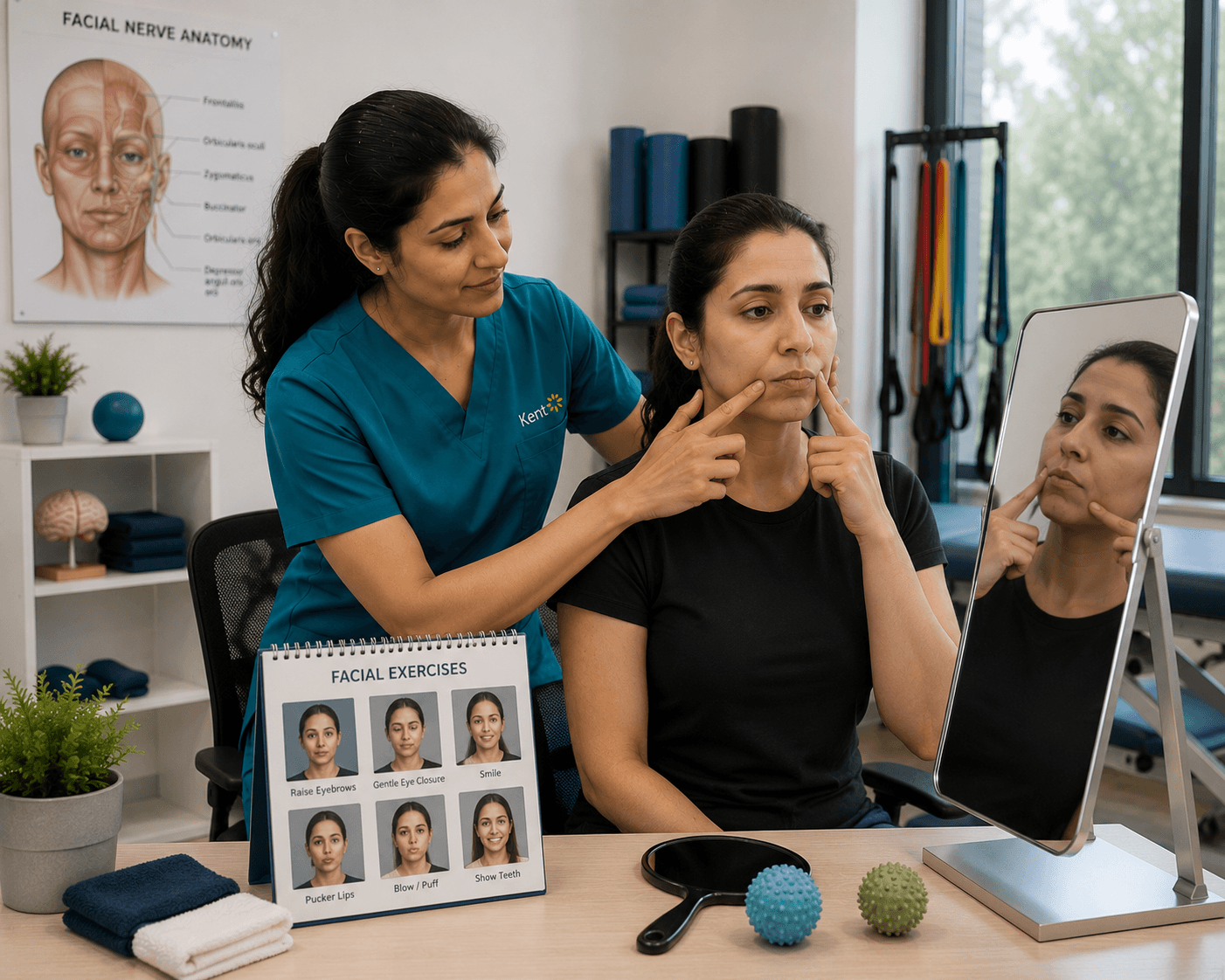
- Neuromuscular retraining using mirror feedback: slow, deliberate practice of specific movements with visual feedback.
- Soft-tissue techniques for affected muscles.
- Patient education about eye protection, a critical issue in the early phase when blink is impaired.
- Botulinum toxin coordination where indicated for synkinesis.
- Long-term home exercise programs.
When to start rehabilitation
For most Bell's palsy patients, rehabilitation can begin once medical treatment (typically corticosteroids and sometimes antivirals) has been initiated. Earlier is generally better, particularly for patients with severe weakness at presentation, those with House-Brackmann grade IV or worse, and patients with persistent weakness at three months.
Outcome measures we use
- House-Brackmann Facial Grading Scale
- Sunnybrook Facial Grading System
- Synkinesis Assessment Questionnaire
- Facial Disability Index
- Photographic and Video Documentation
About the clinician: my journey in facial rehabilitation
Facial rehabilitation at Kent is led by Vishakha Kadam, DHA-licensed physiotherapist with specific training in facial neuromuscular retraining, in the Neurological Rehabilitation practice at Kent Healthcare, Bur Dubai.
[ADD in first person: training and courses, years treating facial palsy and synkinesis, typical recovery stories, and why you focus on this area.]
Meet the Kent team · Related: stroke rehabilitation, brain injury rehabilitation
Frequently asked questions
How long does Bell's palsy take to recover?
Most people start to improve within weeks and recover substantially within three to six months. Some have lasting weakness or synkinesis. If you have not recovered fully by three months, a facial rehabilitation assessment is worthwhile.
Is Bell's palsy a stroke?
No, but they can look alike. Any sudden facial weakness needs urgent medical assessment, because only a doctor can tell them apart. Weakness in an arm or leg, slurred speech, or confusion alongside facial droop is an emergency.
Does physiotherapy help Bell's palsy?
Most people recover without therapy. The evidence suggests tailored facial exercises can help, mainly in moderate and long-standing cases and for reducing synkinesis, which is why we use mirror-feedback neuromuscular retraining.
When should facial rehabilitation start?
Earlier is generally better. We typically begin once medical treatment has started and the patient is past the acute inflammatory phase. For patients with significant weakness or who have not recovered fully by 3 months, rehabilitation is particularly important.
Can rehabilitation help years after Bell's palsy?
Yes. Synkinesis and residual weakness years after Bell's palsy respond to neuromuscular retraining. The improvements take longer to achieve but they're real.
Do you use electrical stimulation for facial palsy?
Generally no. The evidence for electrical stimulation in Bell's palsy is mixed at best, and there's a risk it contributes to synkinesis development. We rely on mirror-feedback neuromuscular retraining.
What about Botox for facial synkinesis?
Botulinum toxin injections can be very helpful for managing synkinesis. We coordinate with a partner provider for the injections and continue the rehabilitation work around them.