Guillain-Barré syndrome (GBS) is an autoimmune condition that damages the peripheral nerves, causing weakness that can range from mild to severe paralysis. Most people recover substantially, but recovery is slow, often 12 to 24 months, and structured rehabilitation speeds it up and protects against complications.
GBS recovery is one of the most rewarding areas of neurological rehabilitation, because most patients make major gains over time. The early weeks after acute medical treatment focus on preventing contractures. The months that follow focus on rebuilding strength, endurance and function step by step.
What is Guillain-Barré syndrome?
GBS happens when the immune system mistakenly attacks the peripheral nerves, the nerves that carry signals between the spinal cord and the muscles and skin.
It often follows an infection, and symptoms usually peak within about four weeks. Acute treatment, such as immunoglobulin therapy or plasma exchange, is given in hospital by the medical team. Rehabilitation takes over as the person becomes stable, and continues through the long recovery phase. A related condition, CIDP, develops more slowly and can relapse, so it is managed over the long term.
Symptoms and effects of GBS
- Tingling or numbness in the feet and hands
- Muscle weakness that spreads upward through the legs, arms and sometimes the face
- Difficulty walking, climbing stairs or standing from a chair
- Nerve pain, cramps or unusual sensations
- Severe tiredness that can last long after strength returns
- In serious cases, difficulty breathing or swallowing, which needs emergency care
What GBS rehabilitation involves
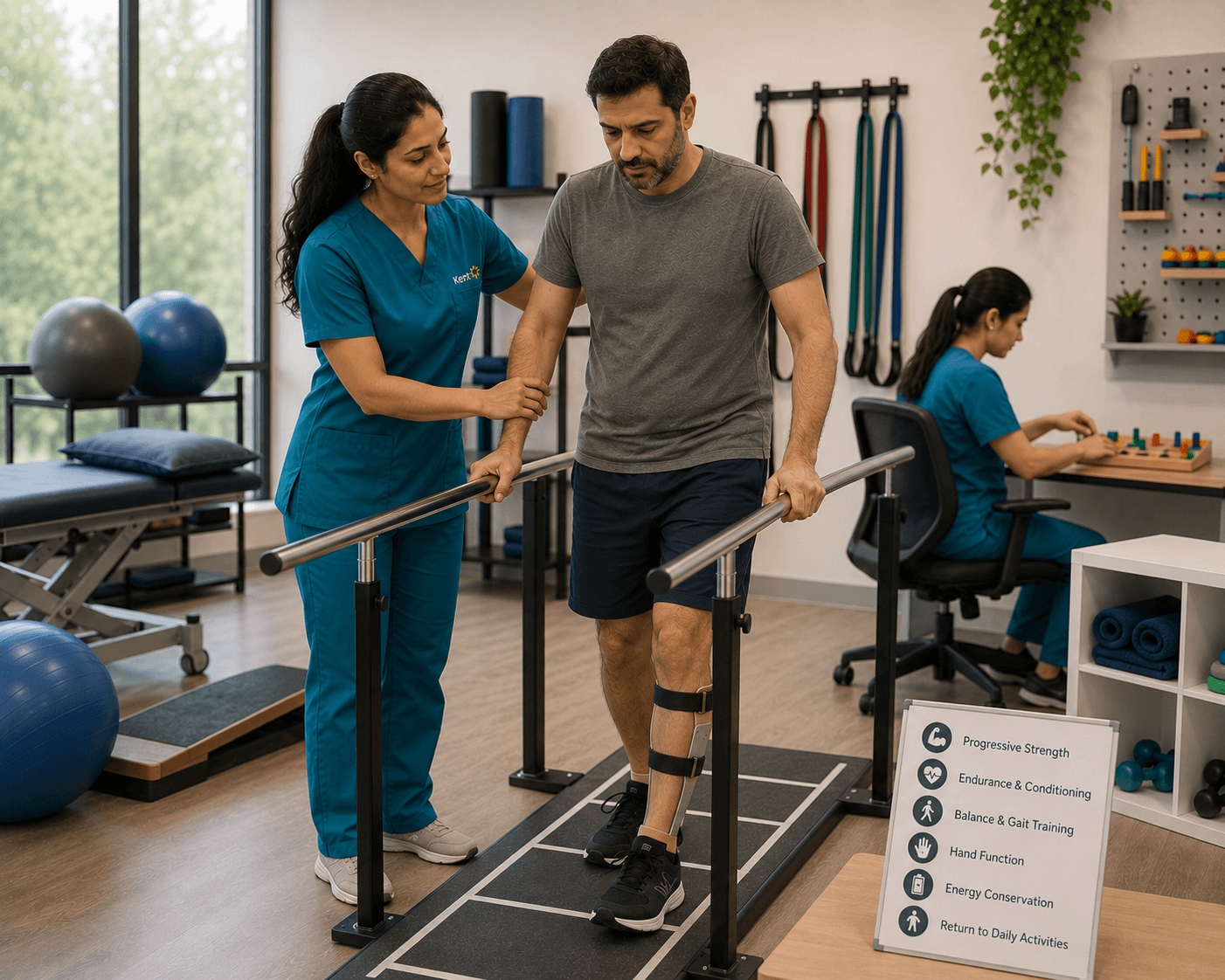
- Progressive strength training in muscle groups as they recover
- Range of motion and contracture prevention
- Endurance and cardiovascular reconditioning, because GBS deconditions people severely
- Gait retraining and balance work
- Hand function and fine motor work
- Energy conservation and fatigue management, since fatigue often persists long after strength returns
- Return-to-work planning
- Adaptive equipment and home modification where significant residual weakness remains
Pacing the program
GBS rehabilitation needs careful dosing. Too little misses recovery opportunities, and too much risks setbacks.
Sessions are scheduled to respect fatigue and the slow, progressive nature of nerve regeneration. We typically see patients two to three times a week in the active recovery phase, tapering as function returns.
Your recovery journey at Kent
- Assessment. A 45-minute clinical assessment of strength, balance, walking, hand function, fatigue and daily activities.
- Goals and plan. A realistic plan built around what matters most to you, such as walking independently, using your hands or returning to work.
- Active recovery phase. Two to three sessions a week, at our clinic or at home, with carefully dosed strengthening, walking and balance work.
- Fatigue management. Pacing and energy strategies you can use in daily life.
- Reassessment. Regular re-measurement with validated scales, with the plan adjusted as nerves recover.
- Tapering and return to life. Sessions reduce as function returns, with support for work, equipment and the home where needed.
How we measure progress
- GBS Disability Score
- Overall Disability Sum Score (ODSS)
- Manual Muscle Testing
- Berg Balance Scale
- 6-Minute Walk Test
- 10-Metre Walk Test
- Fatigue Severity Scale
- Functional Independence Measure (FIM)
When should you seek help?
Start rehabilitation as soon as the medical team confirms you are stable, which is often while you are still in hospital.
If you or a family member has rapidly worsening weakness, tingling that spreads upward, or any difficulty breathing or swallowing, go to the emergency department immediately. These can be signs of GBS and need urgent medical treatment before rehabilitation.
Where we treat
Sessions take place at our clinic in Al Mankhool, Bur Dubai, above Emirates NBD, or at home through Kent at Home, with visits across Dubai, Sharjah and Ajman. Kent Healthcare is licensed by the Dubai Health Authority (DHA-3478614). See our insurance and fees page for coverage details.
Related care: stroke rehabilitation, spinal cord injury rehabilitation and multiple sclerosis rehabilitation.
Frequently asked questions
What is Guillain-Barré syndrome?
Guillain-Barré syndrome (GBS) is a rare autoimmune condition in which the body's immune system attacks the peripheral nerves. It causes tingling, weakness and sometimes paralysis, usually peaking within about four weeks. Most people recover, but recovery is gradual and rehabilitation helps.
What are the symptoms of GBS?
GBS typically starts with tingling or numbness in the feet and hands, followed by weakness that spreads upward, difficulty walking, and sometimes pain, facial weakness or breathing difficulty. Rapidly worsening weakness or trouble breathing needs emergency care.
When should GBS rehabilitation start?
As soon as the patient is medically stable, often while still in hospital. The early weeks are critical for contracture prevention, and the months that follow are when most of the strength and function returns.
How long does GBS recovery take?
It varies. Most patients see significant improvement over 6 to 12 months, with continuing slow improvement for up to 2 years. A minority have lasting residual weakness.
Will I walk again after Guillain-Barré syndrome?
Most GBS patients regain walking. For some, it returns to pre-illness levels, and for others residual weakness or fatigue means walking is more limited. Realistic expectations come from accurate clinical assessment, not from generic statistics.
Why am I still so tired after GBS?
Fatigue is very common after GBS and often lasts long after strength returns. It is part of the condition, not a lack of effort. Pacing, energy conservation and graded reconditioning help manage it.
Can I exercise too much during GBS recovery?
Yes. Recovering nerves tire easily, and too much exercise can cause setbacks, while too little misses recovery opportunities. We dose sessions carefully to respect fatigue and the slow pace of nerve regeneration.
What about CIDP?
Chronic inflammatory demyelinating polyneuropathy is managed by neurology with immunomodulating therapy. Rehabilitation supports function alongside medical treatment and is typically intermittent and long-term.
What is the difference between GBS and CIDP?
GBS comes on quickly and usually peaks within about four weeks, then recovers. CIDP develops more slowly over eight weeks or longer, and may progress or relapse over time. Both affect the peripheral nerves, and a neurologist makes the diagnosis.
Do you offer home visits for GBS rehabilitation?
Yes. Through Kent at Home, therapists visit patients across Dubai, Sharjah and Ajman. Sessions are also available at our clinic in Al Mankhool, Bur Dubai.
Recovering from Guillain-Barré syndrome? Book a 45-minute assessment to get a realistic recovery plan and a program paced to your nerves and energy.