
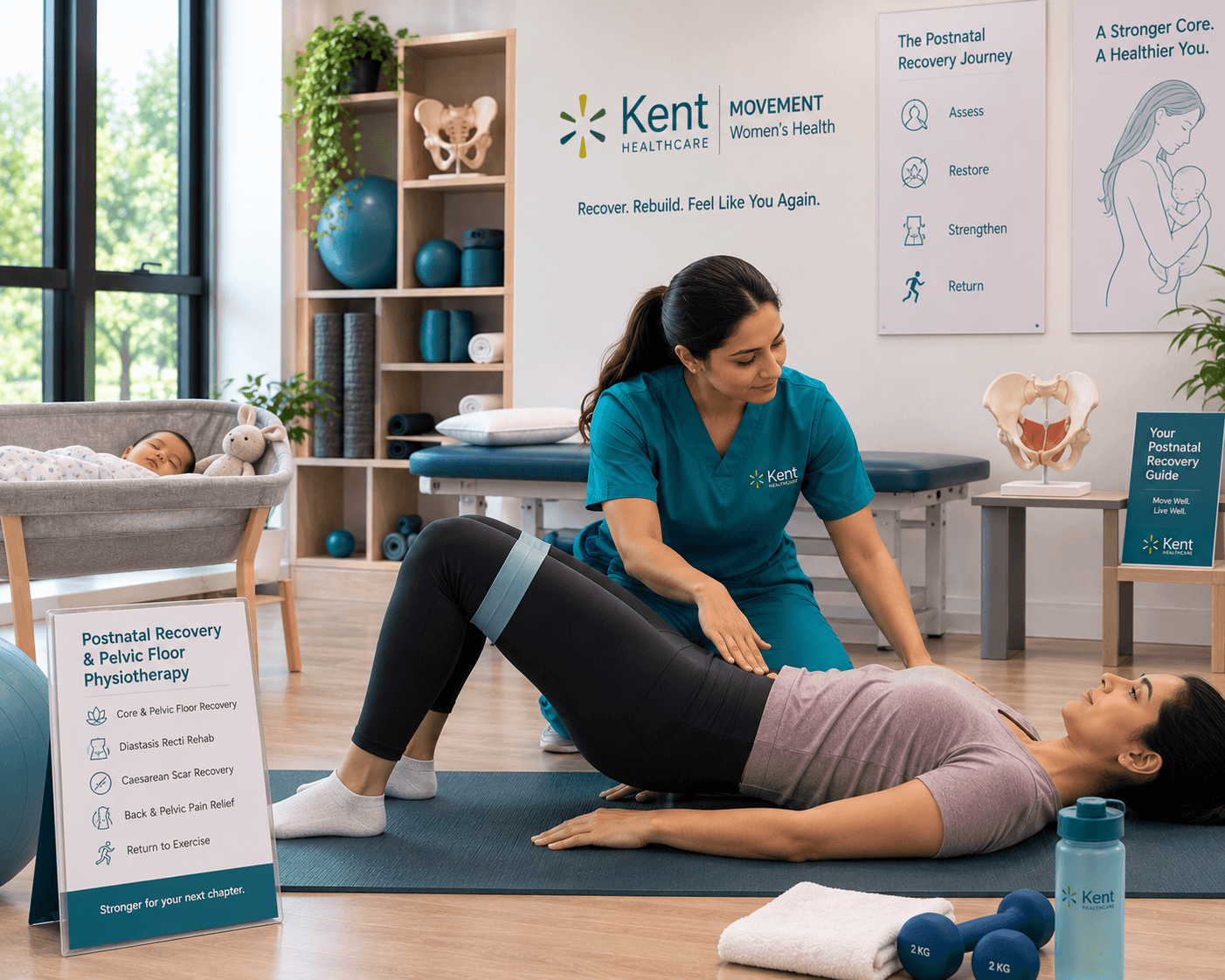
Postnatal physiotherapy is specialist rehabilitation after pregnancy and birth, treating pelvic floor problems such as leaking, diastasis recti, scar and pelvic pain, and guiding a safe return to exercise and running, usually from around 6 weeks postpartum.
Postnatal physiotherapy is often underused in the UAE. Many women receive no structured physical rehabilitation after giving birth, even though pregnancy and delivery affect the abdominal wall, pelvic floor, and posture in ways that don't fully resolve without specific work. Recovery improves with structured rehabilitation.
What we treat
- Diastasis recti (abdominal separation) and core reconnection therapy.
- Pelvic floor dysfunction: stress, urge, and mixed incontinence, and pelvic organ prolapse.
- Perineal pain, perineal scar recovery, and cesarean section scar recovery.
- Pelvic girdle pain and low back pain linked to pregnancy and postnatal posture changes.
- Return to exercise and running with structured programming tailored to postpartum recovery.
When to start postnatal physiotherapy
Initial assessment is appropriate from around 6 weeks postpartum, after the standard 6-week medical check. Earlier consultation is available for specific concerns or complicated births, and there is no upper time limit: many women come months or years after delivery. Seek urgent medical care for heavy bleeding, fever, severe pain, or calf pain or swelling after birth.
Our approach
- Comprehensive assessment, including specific pelvic floor and abdominal evaluation.
- A graded exercise program building from foundational core and pelvic floor work through progressive functional loading.
- Manual therapy where indicated, and scar management for cesarean and perineal scars.
- Education on bladder, bowel, and sexual function recovery.
- Return-to-exercise programming with specific criteria for return to running and impact.
Outcome measures we use
- International Consultation on Incontinence Questionnaire (ICIQ)
- Pelvic Floor Distress Inventory
- Diastasis Recti Measurement (inter-recti distance)
- Visual Analogue Scale
- Patient-Specific Functional Scale
About the clinician: my journey in women's health physiotherapy
Postnatal and pelvic floor physiotherapy at Kent is delivered by Aleena Mathew, physiotherapist with specific women's health and pelvic floor training, in the Movement practice at Kent Healthcare, Bur Dubai.
[ADD in first person: qualifications and pelvic floor training, years treating postnatal women, what you see most often, and why you work in women's health.]
Meet the Kent team · Related: chronic low back pain, sciatica
Frequently asked questions
What is diastasis recti?
Diastasis recti is a separation of the abdominal muscles that often develops during pregnancy. It can cause a bulge along the midline and a sense of core weakness, and structured core and exercise rehabilitation helps in many cases.
What is pelvic floor physiotherapy?
Pelvic floor physiotherapy assesses and retrains the muscles that support the bladder, bowel, and uterus. After birth it addresses leaking, pelvic heaviness, pain, and core weakness using specific assessment and graded exercise.
What are the signs of pelvic floor problems after birth?
Leaking when you cough, sneeze, or exercise; a sudden urgent need to pass urine; a feeling of heaviness or a bulge in the vagina; pain with intimacy; or pelvic and lower back pain. These are common, and assessment can identify what is driving them.
Can physiotherapy help after a C-section?
Yes. Scar management, core reconnection, and graded return-to-exercise are part of our program after cesarean section, once your doctor has cleared you.
When should I start postnatal physiotherapy?
Initial assessment is appropriate from around 6 weeks postpartum (after the standard 6-week medical check). Earlier consultation is available for specific concerns or complicated births.
I had my baby two years ago. Is it too late?
No. There is no upper time limit. Many of our patients come months or years after delivery, often for persistent incontinence, abdominal separation, or pain that they assumed they had to live with. Many respond well to structured rehabilitation.
What about leaking when I sneeze or exercise?
Stress incontinence (leaking with cough, sneeze, lift, or exercise) is common after childbirth, but it is not something you have to accept, and it is treatable. Structured pelvic floor rehabilitation improves or resolves it in many cases.
When can I start running again after giving birth?
Most current guidance recommends a structured progression and not before 12 weeks postpartum at minimum. We have specific return-to-running criteria we assess and we coach women through the progression rather than letting them guess.
Will I see a female therapist?
Yes. Our pelvic floor and postnatal physiotherapy is delivered by female physiotherapists.