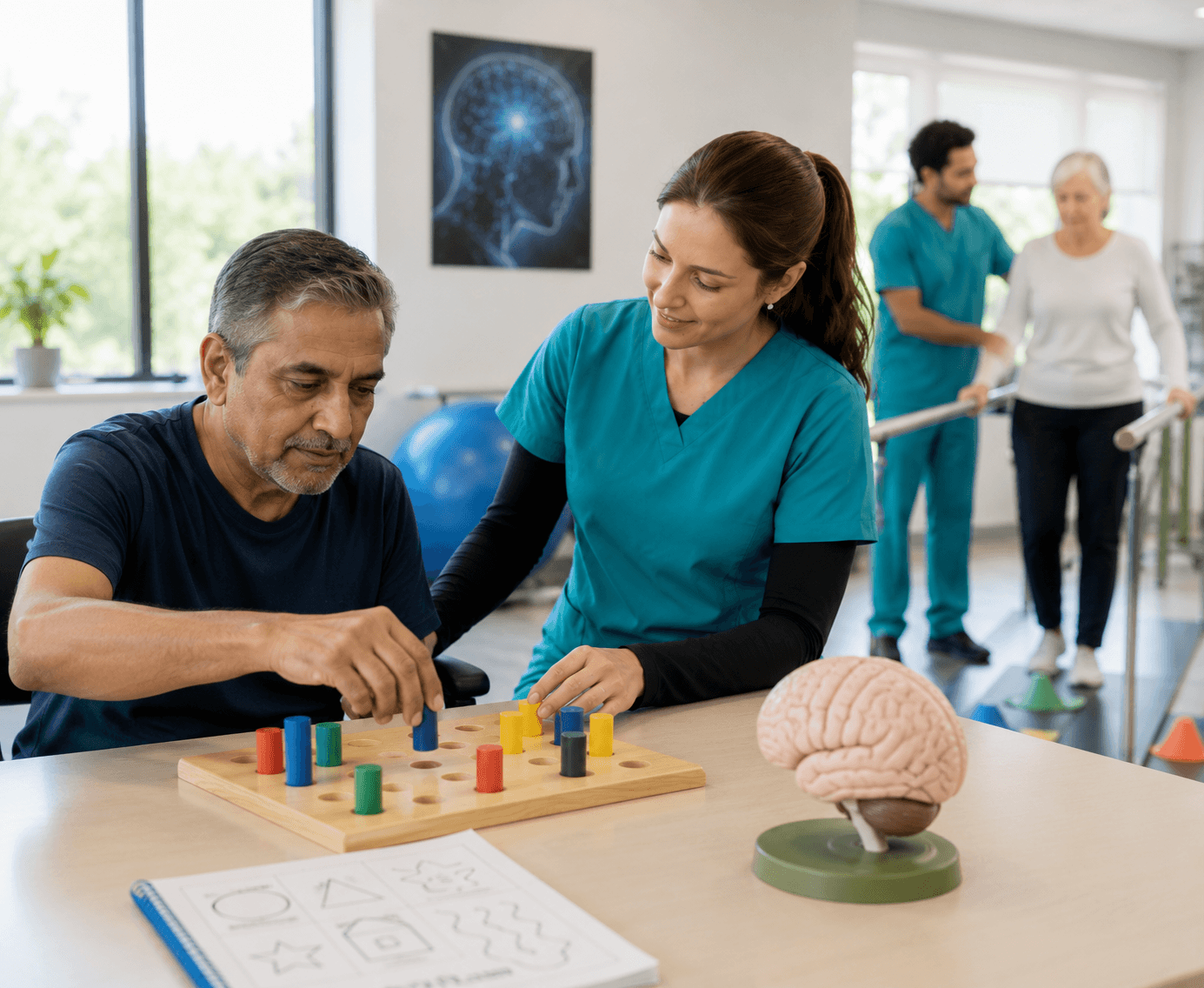
Neurological recovery depends on three things: how quickly therapy begins, the intensity of treatment during the highest-yield window for the condition, and the quality of coordination among the disciplines involved in the patient's care. Recovery is often most responsive during specific periods: the first six months after a stroke, the first two years after a spinal cord injury, and the first few months after a traumatic brain injury. At Kent, we design our neurological programmes to make the most of these critical periods.
Conditions we treat
- Stroke: Ischemic, hemorrhagic, and transient ischemic attack (TIA)
- Traumatic brain injury: Mild (post-concussion syndrome), moderate, and severe
- Spinal cord injury: Complete and incomplete, at any level
- Parkinson's disease and parkinsonian syndromes
- Multiple sclerosis: All forms, all stages
- Motor neuron disease (amyotrophic lateral sclerosis, ALS)
Guillain-Barré syndrome recovery
Post-neurosurgery rehabilitation—post-tumor resection, post-aneurysm repair, post-deep brain stimulation
- Bell's palsy and facial nerve disorders
- Vertigo and vestibular disorders
- Functional neurological disorder
- Post-COVID neurological symptoms
- Cerebellar disorders
Our flagship programs
Back to Life
Stroke Rehabilitation Foundation offers 35 sessions of multidisciplinary therapy structured around the first 12–16 weeks post-stroke.
Revitalize Life
Post-Stroke Recovery Program designed for patients three months or more post-stroke to address residual impairments and restore higher-level function.
Stroke Rehabilitation Foundation (16 sessions): A shorter program for patients with milder strokes or those needing top-up therapy blocks.
Manage Parkinson's Effectively (15 sessions): Anchored on LSVT BIG and LSVT LOUD, focusing on gait, balance training, and fall prevention.
Dizzy No More
Structured vestibular rehabilitation for vertigo and balance disorders.
Cognitive Recovery Pathway
Cognitive rehabilitation for patients following a stroke, TBI, or other acquired brain injury—delivered in partnership with Kent Mind & Neuropsychology.
Why coordinated multidisciplinary matters
A stroke patient typically needs physiotherapy for mobility, occupational therapy for upper-limb function and daily activities, and speech-language therapy for communication and swallowing. Many also need cognitive rehabilitation. Three or four disciplines working in parallel is the difference between modest recovery and significant recovery. At Kent, the disciplines meet weekly to discuss complex patients. The patient has one plan, not four.
Technology
Robotic-assisted therapy for high-repetition motor training (post-stroke upper limb, gait re-education, severe motor weakness). Virtual reality (VR) rehabilitation for balance, coordination, and engagement-driven repetition. Body-weight-supported treadmill training where indicated. Force plates and computerized balance trainers for objective assessment. Technology amplifies what therapists deliver—it does not replace them.
Outcome measures we use
- Fugl-Meyer Assessment (motor recovery after stroke)
- Modified Rankin Scale
- Berg Balance Scale
- Timed Up and Go
- 10-Meter Walk Test
- 6-Minute Walk Test
- Barthel Index
- Functional Independence Measure (FIM)
- ASIA Impairment Scale
- MDS-UPDRS
- Western Aphasia Battery
- Penetration-Aspiration Scale
- Modified Ashworth Scale
Who leads neurological rehabilitation at Kent
Neurological rehabilitation is led by Arun Ambat Bharathan, a DHA-licensed senior neurological physiotherapist with a Master's degree in Physiotherapy and Neurology and 19 yearsof clinical experience.