
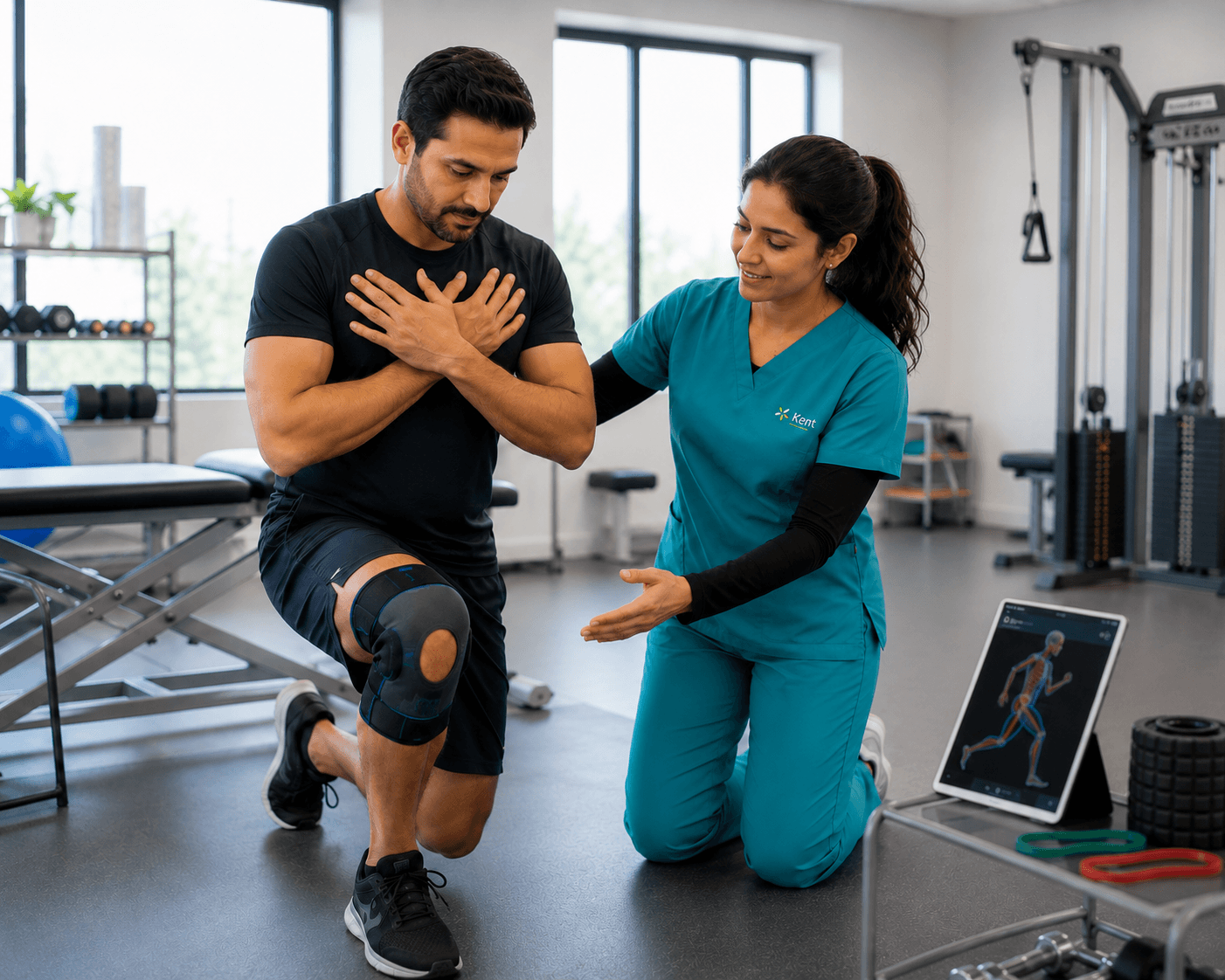
We are not the right place for a single visit to manage a flare-up. We are the right place when something has not resolved with rest, when surgery requires a full rehabilitation pathway, when an injury keeps recurring, or when chronic pain is interfering with your life. We treat trajectories, not episodes.
Post-surgical orthopedic rehabilitation
Surgery is one part of recovery. Rehabilitation is the other. We follow surgeon-specified protocols rigorously while individualizing the program to the patient's broader health, age, and goals.
- Post-total hip replacement
- Post-total knee replacement
- Post-ACL reconstruction
- Post-meniscectomy and meniscal repair
- Post-rotator cuff repair
- Post-arthroscopic shoulder surgery
- Post-spinal fusion and discectomy
- Post-fracture rehabilitation (upper limb, lower limb, spine)
- Post-Achilles tendon repair
- Post-hand surgery
Musculoskeletal and chronic conditions
Many patients come to us when a problem has not resolved with rest, painkillers, or a single treatment. Our approach is structured rehabilitation—progressive loading, motor control, and patient education — rather than passive symptom management.
- Chronic low back pain and sciatica
- Lumbar radiculopathy and disc-related pain
- Neck pain and cervical disorders
- Cervicogenic headache
- Frozen shoulder (adhesive capsulitis)
- Subacromial impingement and rotator cuff tendinopathy
- Tennis elbow and golfer's elbow
- Achilles tendinopathy
- Patellar tendinopathy
- Hip impingement and labral pathology
- Repetitive strain injuries
Sports rehabilitation
For amateur and professional athletes-acute injury rehabilitation, post-surgical return-to-sport, and overuse injury management. Programs include strength and conditioning components tailored to the sport, biomechanical assessment, and progressive return-to-play criteria.
Women's health and postnatal rehabilitation
- Postnatal recovery—abdominal and pelvic floor rehabilitation
- Diastasis recti
- Pelvic floor dysfunction—stress incontinence, urge incontinence, prolapse
- Pregnancy-related musculoskeletal pain
- Pre- and post-surgical pelvic health
Our approach
Manual therapy where indicated, but never as the whole program. The strongest evidence in musculoskeletal physiotherapy supports active rehabilitation—progressive loading, motor control retraining, and condition-specific exercise—combined with patient education and pacing strategies. We use modalities (ultrasound, TENS, electrotherapy, dry needling, shockwave) only when they add measurable value, not as standalone treatments.
Outcome measures we use
- Visual Analogue Scale
- Numeric Pain Rating Scale
- Oswestry Disability Index
- Neck Disability Index
- DASH
- Lower Extremity Functional Scale
- KOOS
- HOOS
- Tegner Activity Scale
- Y-Balance Test
- Functional Movement Testing
- Sport-Specific Return-to-Play Testing
Who leads Movement at Kent
Kent Movement is led by Tresha Parmar, a DHA-licensed senior physiotherapist with a Master's degree in Physiotherapy, Musculoskeletal and Sports, and 4+ years of experience in orthopedic and sports rehabilitation.