
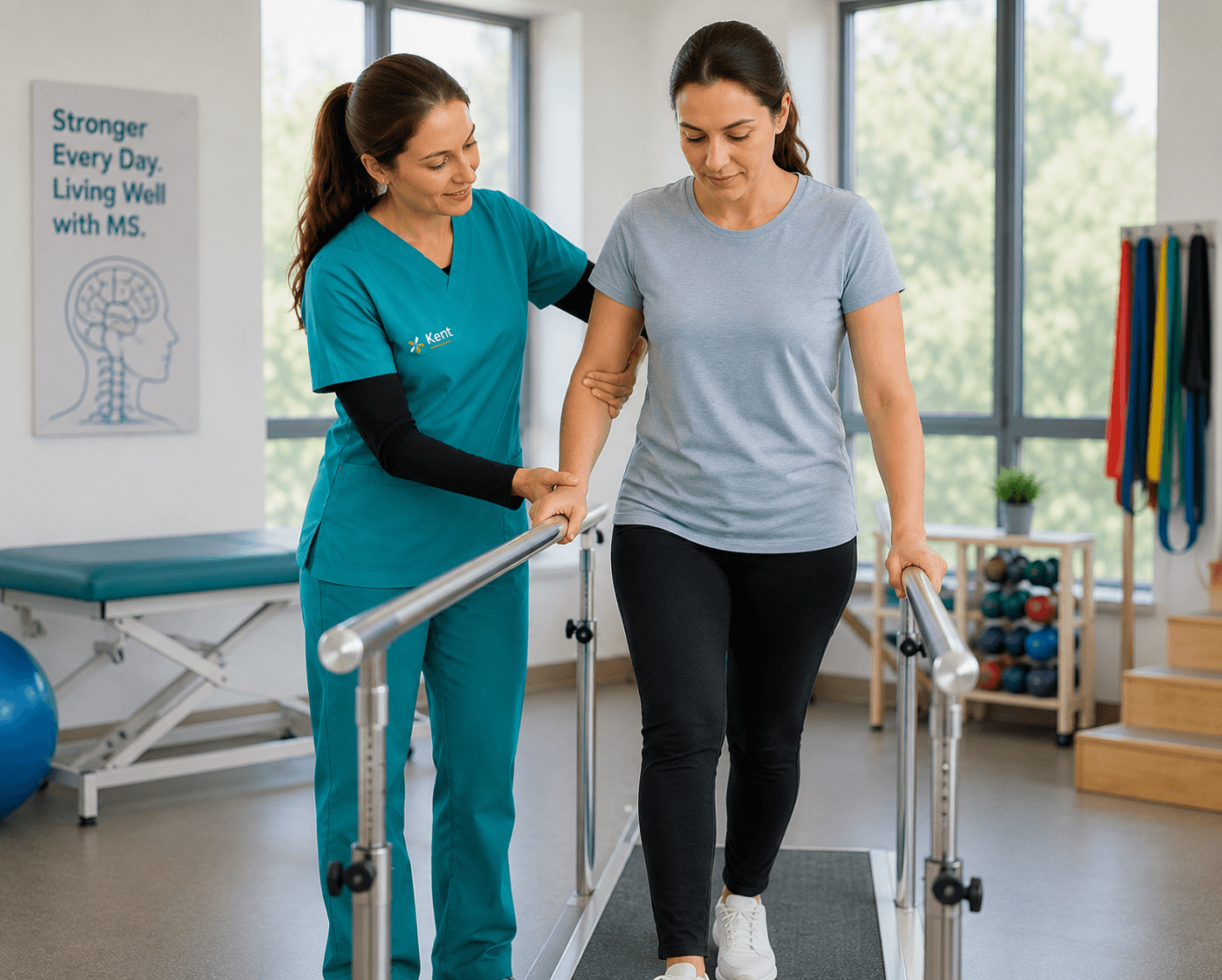
MS rehabilitation does not change the underlying disease, but it helps you move better, manage fatigue and stay independent. It focuses on three priorities: maintaining and improving function during stable periods, recovering function after relapses, and managing fatigue.
MS presents differently in every person, so treatment is highly individualized. We usually work in shorter intensive blocks (typically 6 to 8 weeks) followed by maintenance reviews. That pattern fits MS energy management better than continuous therapy.
What is multiple sclerosis?
Multiple sclerosis is a chronic condition in which the immune system damages the protective covering of nerves in the brain and spinal cord, disrupting the signals between the brain and body.
Common effects include fatigue, weakness, balance and walking problems, stiffness (spasticity), numbness or tingling, bladder problems and changes in thinking. Some people have relapses followed by recovery (relapsing-remitting MS), and some have gradual progression (secondary or primary progressive MS). Diagnosis, relapse treatment and disease-modifying therapy are led by your neurologist. Rehabilitation works alongside them.
What we work on
- Balance and falls: reducing fall risk and improving stability
- Walking: speed, endurance and gait quality
- Spasticity and limb function: upper- and lower-limb stiffness, and fine motor tasks
- Fatigue and energy: energy conservation and pacing
- Cognition: retraining of attention, processing speed and memory
- Bladder and pelvic floor: support alongside our pelvic health specialists
- Speech and swallowing: therapy where indicated
- Equipment and long-term exercise: adaptive equipment and tailored exercise for long-term management
Fatigue management
Fatigue is one of the most disabling MS symptoms, and one of the most modifiable.
Our approach combines energy conservation training, pacing strategies, structured exercise (which can reduce fatigue when dosed correctly), sleep optimization and cognitive-behavioral strategies. Fatigue management runs through every MS program rather than being a separate intervention.
MS and Dubai's heat
Heat can temporarily worsen MS symptoms such as weakness, blurred vision and fatigue. In the UAE climate, planning matters. Your therapist will help you schedule activity for cooler parts of the day, use cooled indoor spaces and plenty of fluids, and adjust exercise intensity so you stay active without overheating.
Working with your neurologist
MS care needs ongoing coordination between neurology (disease-modifying therapy and relapse management) and rehabilitation (function). We send written progress reports to your neurologist at every reassessment, adjust the rehabilitation plan around relapses and medication changes, and refer back promptly if we notice symptoms that need medical review.
Your journey at Kent
- Assessment. A 45-minute assessment of balance, walking, strength, hand function, fatigue and thinking, with a review of your latest neurology information.
- Goals and plan. A plan built around what matters most to you, such as walking farther, working, or lowering fall risk.
- Intensive block. Typically 6 to 8 weeks of therapy, at our clinic or at home.
- Maintenance reviews. Check-ins and tune-ups between blocks to protect your gains.
- Relapse plan. We adjust around relapses, and restart rehabilitation as soon as you are stable.
- Reports to your neurologist. Written updates at every reassessment.
How we measure progress
- Expanded Disability Status Scale (EDSS, coordinated with neurology)
- Multiple Sclerosis Impact Scale (MSIS-29)
- Fatigue Severity Scale
- Modified Fatigue Impact Scale
- Timed 25-Foot Walk
- 9-Hole Peg Test
- Berg Balance Scale
- Symbol Digit Modalities Test
- 6-Minute Walk Test
When should you seek help?
Contact us at diagnosis, or whenever fatigue, balance, walking or thinking start to affect daily life.
New symptoms, or old symptoms that return or worsen for more than 24 hours, may be a relapse, so contact your neurologist. Seek urgent care for sudden loss of vision, severe weakness, or difficulty breathing or swallowing.
Where we treat
Sessions take place at our clinic in Al Mankhool, Bur Dubai, above Emirates NBD, or at home through Kent at Home, with visits across Dubai, Sharjah and Ajman. Kent Healthcare is licensed by the Dubai Health Authority (DHA-3478614). See our insurance and fees page for coverage details.
Related care: stroke rehabilitation, Parkinson's therapy and vertigo and vestibular rehabilitation.
Frequently asked questions
What is multiple sclerosis (MS)?
Multiple sclerosis is a chronic condition in which the immune system damages the protective covering of nerves in the brain and spinal cord. It can cause fatigue, weakness, balance and walking problems, spasticity, numbness, bladder problems and changes in thinking. It looks different in every person, and can be relapsing-remitting or progressive.
When is the right time to start rehabilitation for MS?
At diagnosis, rather than after significant disability develops. Early involvement in rehabilitation establishes a clear functional baseline, builds exercise tolerance during stable periods, and creates a trusted relationship with a team ready to respond quickly when needs change. Do not wait for symptoms to worsen.
Can rehabilitation slow MS progression?
Disease progression is determined by the underlying MS process and modified by disease-modifying therapy under your neurologist. Rehabilitation does not change the disease, but it can improve and preserve functional capability at every stage.
What about exercise? Won't it make MS worse?
No. Appropriate exercise is recommended for MS and is linked to better fatigue, mobility, mood, cognition and quality of life. The key is appropriate dosing, avoiding overheating and severe fatigue, and adapting to your current capacity.
Can you help during or after an MS relapse?
Yes. Acute relapses are managed medically by your neurologist. Post-relapse rehabilitation begins as soon as you are stable and helps recover function and prevent secondary deconditioning.
Do you treat MS-related fatigue?
Yes, as a core part of the program, not a separate issue. Fatigue management runs through every MS program, using pacing, energy conservation, structured exercise, sleep strategies and cognitive-behavioral approaches.
Can rehabilitation help with memory and thinking problems in MS?
Yes. Cognitive rehabilitation targets attention, processing speed and memory, and teaches practical strategies for work and daily life. We track progress with validated tests such as the Symbol Digit Modalities Test.
What about bladder and pelvic floor problems?
Many people with MS have bladder symptoms or pelvic floor dysfunction. Our Movement practice's pelvic health specialists work alongside the neurological team where relevant.
How do you work with my neurologist?
MS care needs ongoing coordination between neurology, which handles disease-modifying therapy and relapse management, and rehabilitation, which focuses on function. We send written progress reports at every reassessment, adjust the plan around relapses and medication changes, and refer back promptly if we notice symptoms needing medical review.
Do you offer home visits for MS rehabilitation?
Yes. Through Kent at Home, therapists visit patients across Dubai, Sharjah and Ajman. Sessions are also available at our clinic in Al Mankhool, Bur Dubai.
Living with MS? Book a 45-minute assessment to get a clear baseline, a plan for fatigue, balance and walking, and a team that works alongside your neurologist.