
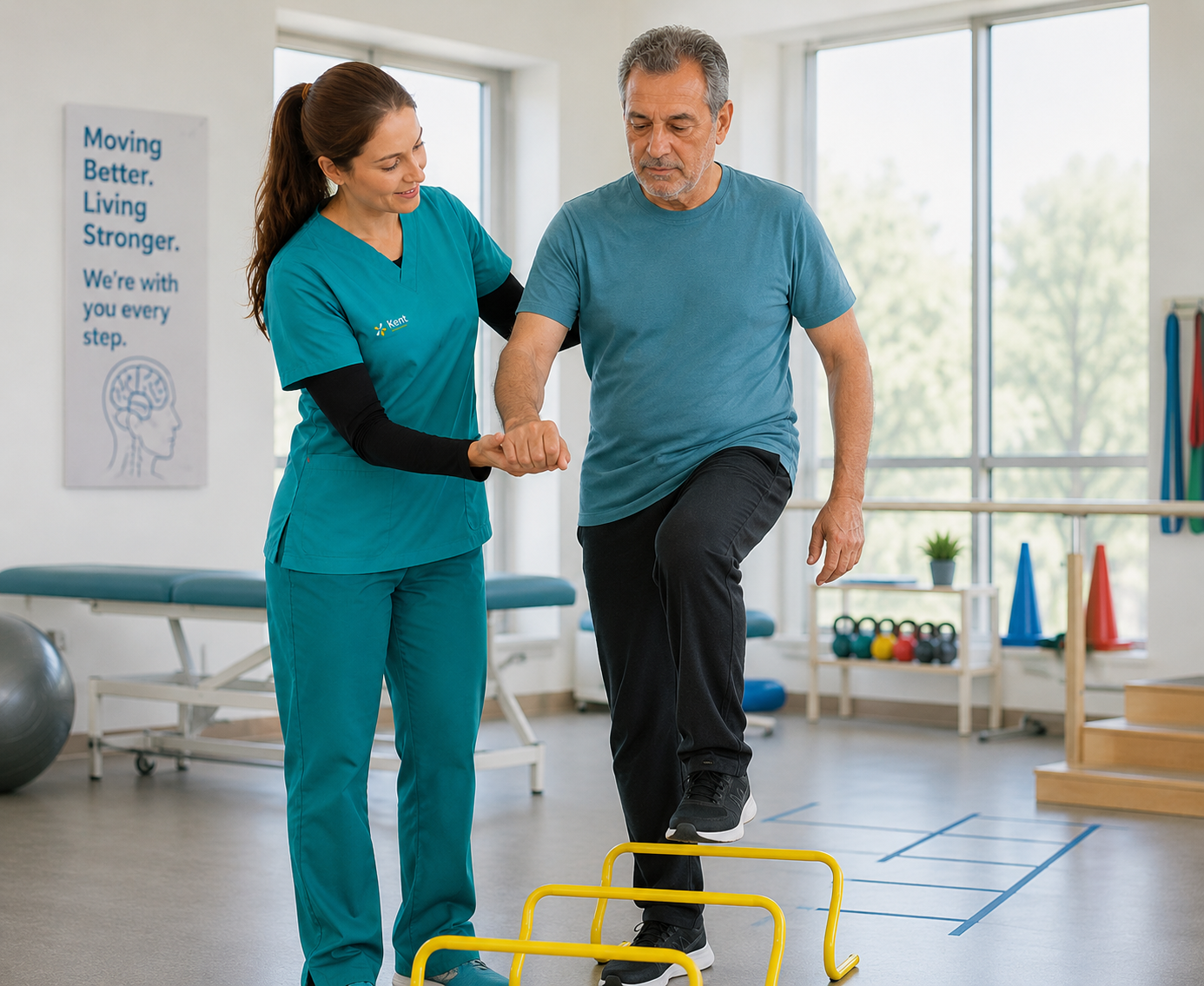
Parkinson's disease is progressive—but its functional impact is highly modifiable through structured rehabilitation. Two evidence-based approaches form the spine of our program: LSVT BIG for movement amplitude and motor function, and LSVT LOUD for voice and speech. Both deliver short, intensive blocks of high-intensity therapy followed by maintenance—a model that produces better functional outcomes than continuous low-intensity treatment.
Our program
Manage Parkinson's Effectively—15 sessions. This is a structured multidisciplinary program built around LSVT BIG, LSVT LOUD for patients with speech and voice difficulties, gait and balance training, fall prevention, and family coaching. Patients are reassessed at the end of each treatment block, and many return for periodic booster sessions as the disease progresses.
What we work on
We target primary motor symptoms including bradykinesia, rigidity, tremor, and postural instability. Treatment plans address gait impairments, freezing of gait, fall prevention, and posture correction, alongside speech and swallowing therapies for volume loss, monotone delivery, and dysarthria. Additionally, we assist with activities of daily living, offer cognitive support where affected, and provide tailored exercise prescriptions for long-term disease management.
Our approach
Short, intensive blocks of high-quality therapy produce better Parkinson's outcomes than continuous low-intensity treatment. Most patients enter a 4-week intensive block of LSVT BIG (16 sessions over 4 weeks), often combined with LSVT LOUD where voice is affected, then transition to a maintenance phase with periodic return blocks. We work closely with the patient's neurologist, particularly around medication timing and disease staging.
Outcome measures we use
- MDS-UPDRS (Movement Disorder Society Unified Parkinson's Disease Rating Scale)
- Timed Up and Go
- Berg Balance Scale
- 10-Metre Walk Test
- Voice Handicap Index
- Parkinson's Disease Questionnaire (PDQ-39)
- Mini-BESTest
Who leads this work at Kent
Parkinson's therapy at Kent is led by Shreedip Patil, LSVT BIG and LSVT LOUD certified.
Frequently asked questions
When should someone with Parkinson's start rehabilitation?
As early as possible after diagnosis. Early rehabilitation extends independent function, reduces falls, and slows the progression of secondary problems (deconditioning, social withdrawal). Don't wait for symptoms to become severe.
What is LSVT BIG?
LSVT BIG is an evidence-based exercise protocol designed specifically for Parkinson's disease. It uses high-amplitude, high-effort movements over a structured four-week block to retrain the brain to move bigger. Strong evidence supports it for motor function, gait, and balance.
What is LSVT LOUD?
LSVT LOUD is the speech and voice equivalent of LSVT BIG—a structured four-week program training high-amplitude voice production. It addresses the soft, monotone speech that develops in many Parkinson's patients.
Does Parkinson's rehabilitation slow disease progression?
Rehabilitation does not change the underlying disease, which is managed by your neurologist with medication. But it consistently improves and preserves functional capability—mobility, voice, fall risk, independence—at every stage.
Can rehabilitation help with freezing of gait?
Yes. Freezing of gait is one of the most common and disabling Parkinson's symptoms, and it responds to specific techniques—cueing strategies (visual, auditory, tactile), motor planning work, environmental modification.
What about deep brain stimulation (DBS) patients?
Patients with DBS devices benefit from structured rehabilitation both before and after surgery. We coordinate with the patient's neurosurgical and neurology team and adapt the program to the device settings.