
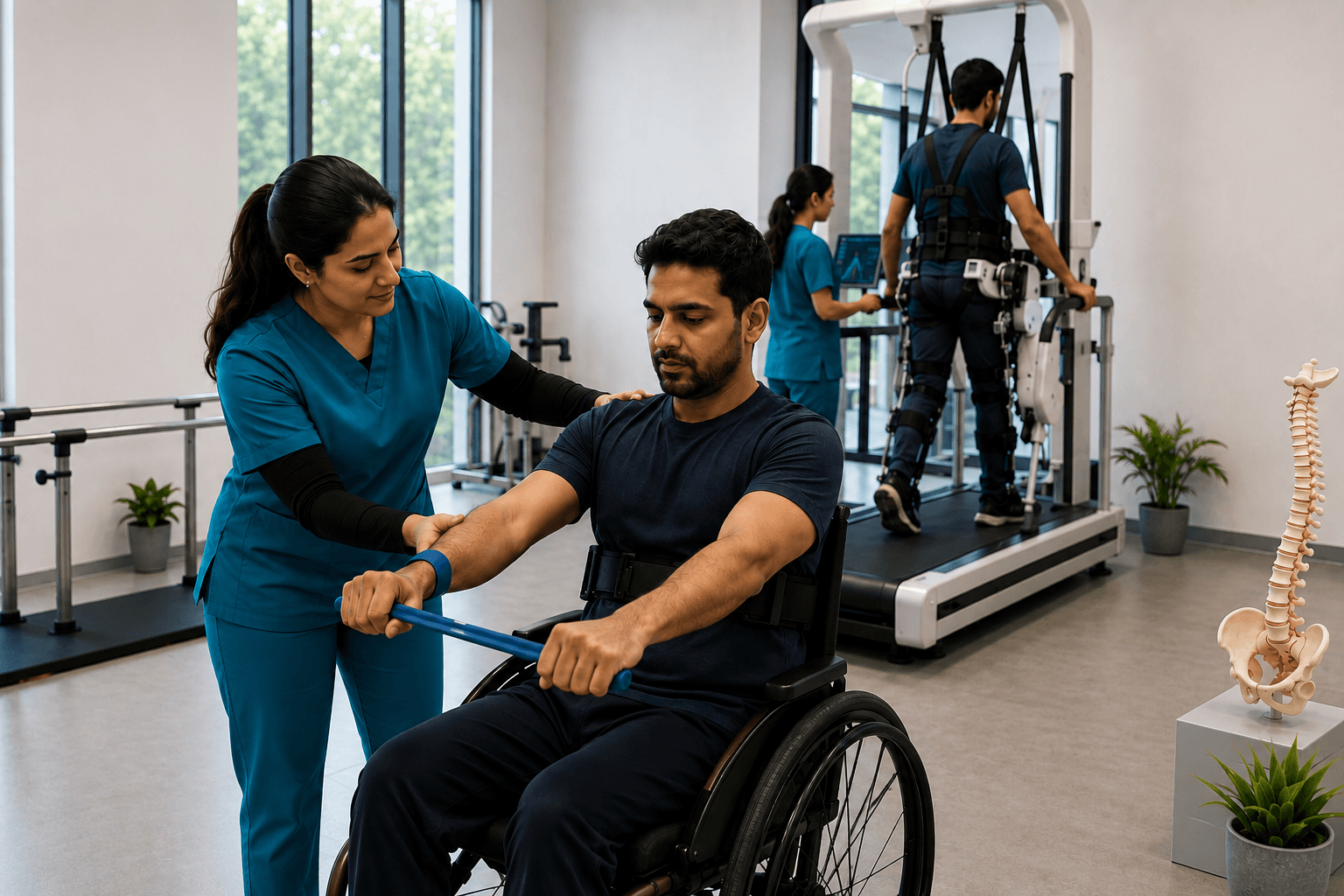
SCI rehabilitation is one of the most complex and long-term rehabilitation pathways. Treatment depends entirely on the level and completeness of the injury. The earliest months after injury are critical for preventing secondary complications,maximizing neurological recovery where it remains possible, and establishing the functional skills the patient will need for the rest of their life.
What SCI rehabilitation involves
Rehabilitation focuses on strength training for residual functional muscles, range-of-motion exercises to prevent contractures, and sitting balance and trunk control. Patients practice essential transfers—including bed, wheelchair, toilet, and car movements—alongside wheelchair propulsion, ramp and curb navigation, and fall recovery. Care plans incorporate upper-limb hand therapy (particularly for tetraplegia), robotic gait training where indicated, and spasticity management. Additionally, we provide comprehensive education on bladder, bowel, and skin care, guide adaptive equipment selection and home modifications, and offer family training in safe handling.
Robotic-assisted training for SCI
For patients with incomplete spinal cord injuries, robotic gait training and body-weight-supported treadmill training enable high-repetition, accurate locomotor practice that manual therapy alone cannot deliver at therapeutic dose. Suitability is determined during clinical assessment based on ASIA level, current motor function, cardiovascular tolerance, and skin integrity.
Working with your medical team
Patients with spinal cord injuries (SCI) typically have a complex care team—including neurosurgeons, urologists, plastic surgeons (for skin integrity), psychologists, and social workers. We coordinate closely with all of them. We send written progress reports at every reassessment and make prompt referrals when we identify issues requiring medical review, such as autonomic dysreflexia, urinary tract infections, or pressure injury risks.
Outcome measures we use
- ASIA Impairment Scale (AIS)
- Spinal Cord Independence Measure (SCIM)
- Walking Index for Spinal Cord Injury (WISCI II)
- 10-Metre Walk Test
- 6-Minute Walk Test
- Berg Balance Scale (where applicable)
- Functional Independence Measure (FIM)
- Modified Ashworth Scale
Who leads this work at Kent
SCI rehabilitation at Kent is led by Mohammed Jamsheer TPM, DHA-licensed neurological physiotherapist with specific training in spinal cord injury rehabilitation.
Frequently asked questions
When should SCI rehabilitation start?
As early as possible after the patient is medically stable. The earliest months after injury are critical. For patients still in hospital, we can begin assessment and planning before discharge.
Will the patient walk again?
Depends entirely on the injury—level, completeness, age, time since injury, secondary medical issues. We give an expert clinical opinion at assessment based on ASIA classification. For incomplete injuries, walking recovery is often possible. For complete injuries above certain levels, it is not—and rehabilitation focuses on a different set of capabilities.
How long does SCI rehabilitation take?
Initial intensive rehabilitation typically runs six to twelve months. Long-term, most SCI patients return to rehabilitation periodically across their lives—for new goals, for changes in function, after medical events, and for equipment changes.
Do you offer home-based SCI rehabilitation?
Yes. Many SCI patients begin with home-based therapy after hospital discharge and transition to clinic as transport and equipment allow.
What about urinary and bowel management?
These are typically managed by urology and the patient's primary medical team. We educate patients and families, monitor for complications, and refer back to medicine promptly when needed.