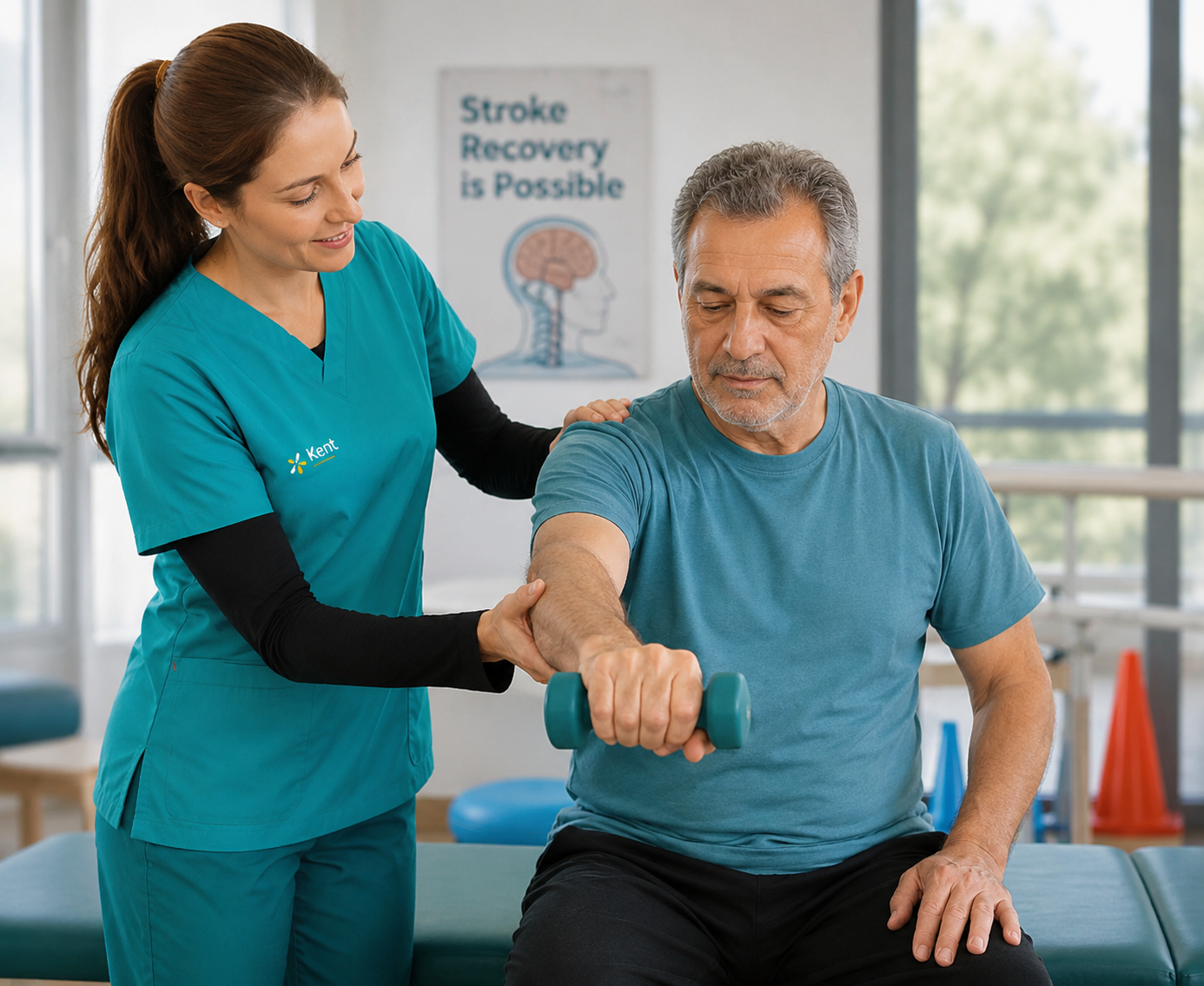
Stroke recovery depends on three things: how quickly rehabilitation begins, the intensity of therapy in the first six months, and the quality of coordination between the disciplines treating the patient. The first six months post-stroke are the highest-yield window for motor and language recovery—delaying rehabilitation reduces the functional ceiling the patient is likely to reach. We design our stroke programs to use this window properly.
What post-stroke rehabilitation involves
Stroke affects different patients differently. Some need work on walking, balance, and lower-limb strength. Others have lost upper-limb function and need extensive arm and hand rehabilitation. Many have aphasia (language difficulty) or dysarthria (slurred speech) and need speech-language therapy. Many have dysphagia (swallowing difficulty), which requires specific clinical work to prevent aspiration. Many have cognitive changes—attention, memory, executive function—that need cognitive rehabilitation. The right program depends on the specific impairments.
Our stroke programs
Back to Life
Stroke Rehabilitation Foundation: 35 sessions of multidisciplinary therapy structured around the first 12–16 weeks post-stroke. Designed for the early recovery window when intensity matters most.Revitalize Life
Post-Stroke Recovery Program: For patients three months or more post-stroke, working on residual impairments and return to higher-level function (work, driving, community participation).Stroke Rehabilitation Foundation (16 sessions): A shorter program for patients with milder strokes or for top-up blocks after Back to Life.
Our approach
All sessions are one-to-one, never group sessions.Multiple disciplines are coordinated under a single treatment plan with shared functional goals. The team meets weekly to discuss complex cases. Treatment combines neurological physiotherapy (gait, balance, strength), occupational therapy (upper-limb function, daily activities, ADL Room training), speech and swallowing therapy where indicated, robotic-assisted training for high-repetition motor work, VR rehabilitation for engagement and complex motor tasks, and cognitive rehabilitation where cognition is affected.
Outcome measures we use
- Fugl-Meyer Assessment (motor recovery)
- Modified Rankin Scale (global function)
- Berg Balance Scale
- 10-Metre Walk Test
- 6-Minute Walk Test
- Barthel Index
- Functional Independence Measure (FIM)
- Western Aphasia Battery
- Penetration-Aspiration Scale
- Modified Ashworth Scale
Who leads this work at Kent
Stroke rehabilitation is led by Arun Ambat Bharathan,a DHA-licensed senior neurological physiotherapist.
Frequently asked questions
When should stroke rehabilitation start?
As soon as the patient is medically stable, ideally within days of the stroke. The first six months are the highest-yield window for motor and language recovery; delay reduces the functional ceiling. We can begin at home for patients who are not yet ready to travel to clinic.
How long does stroke rehabilitation take?
Stroke recovery is measured in months, not weeks. Most patients are in active multidisciplinary rehabilitation for six to twelve months, with intensity tapering over time. After active rehabilitation, many patients return for periodic blocks.
How often will I need to come?
Typical active programs run three to four sessions per week. Frequency matters—research consistently shows that lower-intensity programs produce smaller functional gains.
Can rehabilitation help if the stroke was a long time ago?
Yes. The strongest gains are in the first six months, but meaningful functional improvement is possible years after a stroke—particularly when patients have not had access to structured multidisciplinary rehabilitation previously.
Do you provide home-based stroke rehabilitation?
Yes. Kent at Home delivers physiotherapy, occupational therapy, speech and swallowing therapy at the patient's address across Dubai, Sharjah, and Ajman.
Is stroke rehabilitation covered by health insurance in the UAE?
Many UAE insurers cover post-stroke physiotherapy, occupational therapy, and speech therapy when clinically indicated. Coverage varies by policy. Contact us before booking and we will verify benefits and pre-approvals.
Will the patient recover fully?
It depends on the stroke. Severity, location, time to treatment, age, and pre-stroke health all matter. Most patients with appropriate rehabilitation achieve significant functional recovery, though many have some lasting effects. We give an expert clinical opinion at assessment, not a marketing promise.