
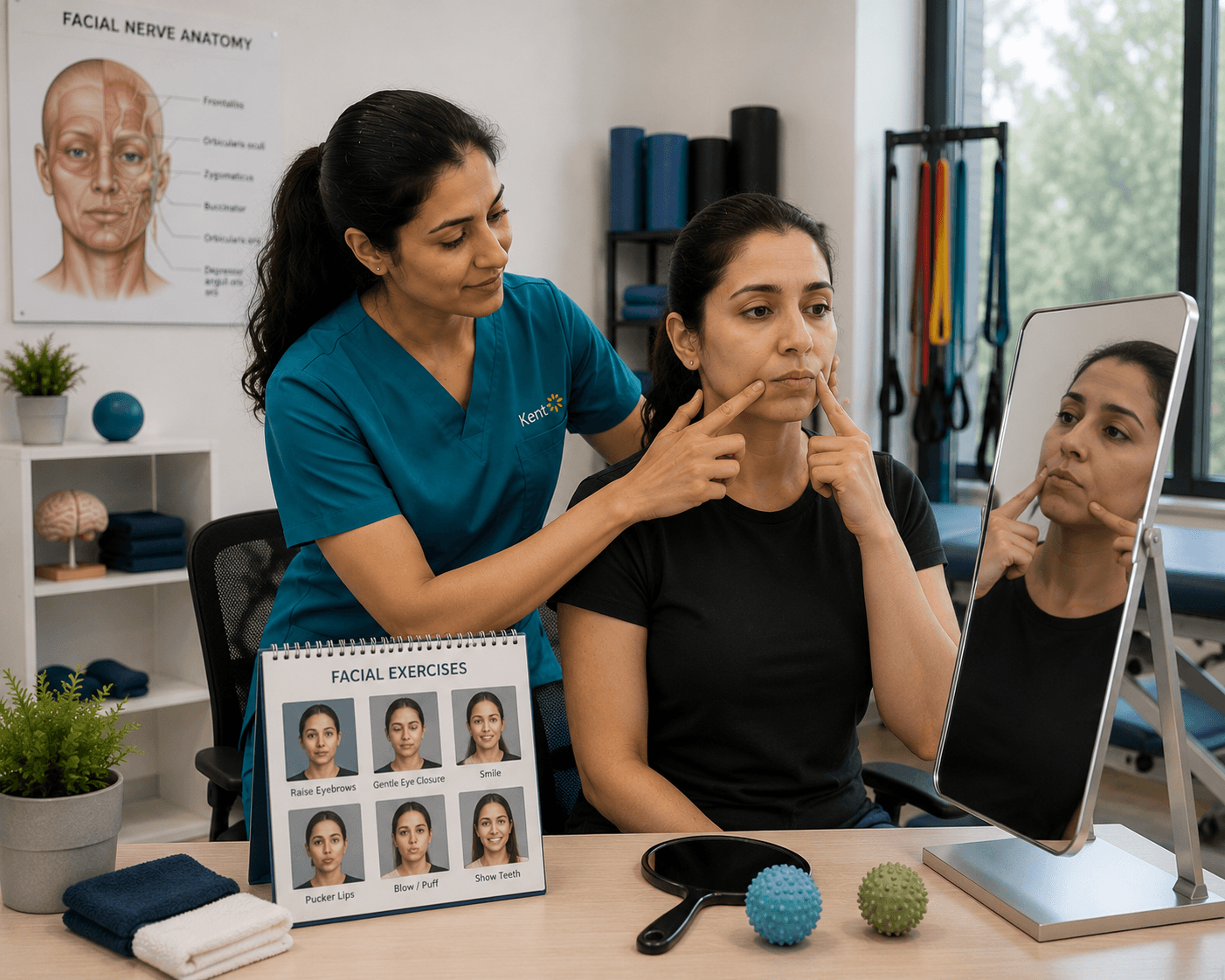
Most Bell's palsy patients recover substantially within three to six months with or without rehabilitation. But rehabilitation matters specifically for the patients who don't fully recover, who develop synkinesis, or whose recovery would benefit from earlier targeted intervention. The goal is not just to recover movement—it's to recover correct, coordinated movement.
What facial rehabilitation involves
Detailed assessment of facial movement, symmetry, and synkinesis using validated grading scales. Neuromuscular retraining using mirror feedback—slow, deliberate practice of specific movements with visual feedback. Soft-tissue techniques for affected muscles. Patient education about eye protection (a critical issue in the early phase when blink is impaired). Botulinum toxin coordination where indicated for synkinesis. Long-term home exercise programs.
When to start rehabilitation
For most Bell's palsy patients, rehabilitation can begin once medical treatment (typically corticosteroids and sometimes antivirals) has been initiated. Earlier is generally better, particularly for patients with severe weakness at presentation, those with House-Brackmann grade IV or worse, and patients with persistent weakness at three months.
Outcome measures we use
- House-Brackmann Facial Grading Scale
- Sunnybrook Facial Grading System
- Synkinesis Assessment Questionnaire
- Facial Disability Index
- Photographic and Video Documentation
Who leads this work at Kent
Facial rehabilitation at Kent is led by Vishakha Kadam, DHA-licensed physiotherapist with specific training in facial neuromuscular retraining.
Frequently asked questions
When should facial rehabilitation start?
Earlier is generally better. We typically begin once medical treatment has started and the patient is past the acute inflammatory phase. For patients with significant weakness or who have not recovered fully by 3 months, rehabilitation is particularly important.
Can rehabilitation help years after Bell's palsy?
Yes. Synkinesis and residual weakness years after Bell's palsy respond to neuromuscular retraining. The improvements take longer to achieve but they're real.
Do you use electrical stimulation for facial palsy?
Generally no. The evidence for electrical stimulation in Bell's palsy is mixed at best, and there's a risk it contributes to synkinesis development. We rely on mirror-feedback neuromuscular retraining.
What about Botox for facial synkinesis?
Botulinum toxin injections can be very helpful for managing synkinesis. We coordinate with a partner provider for the injections and continue the rehabilitation work around them.