
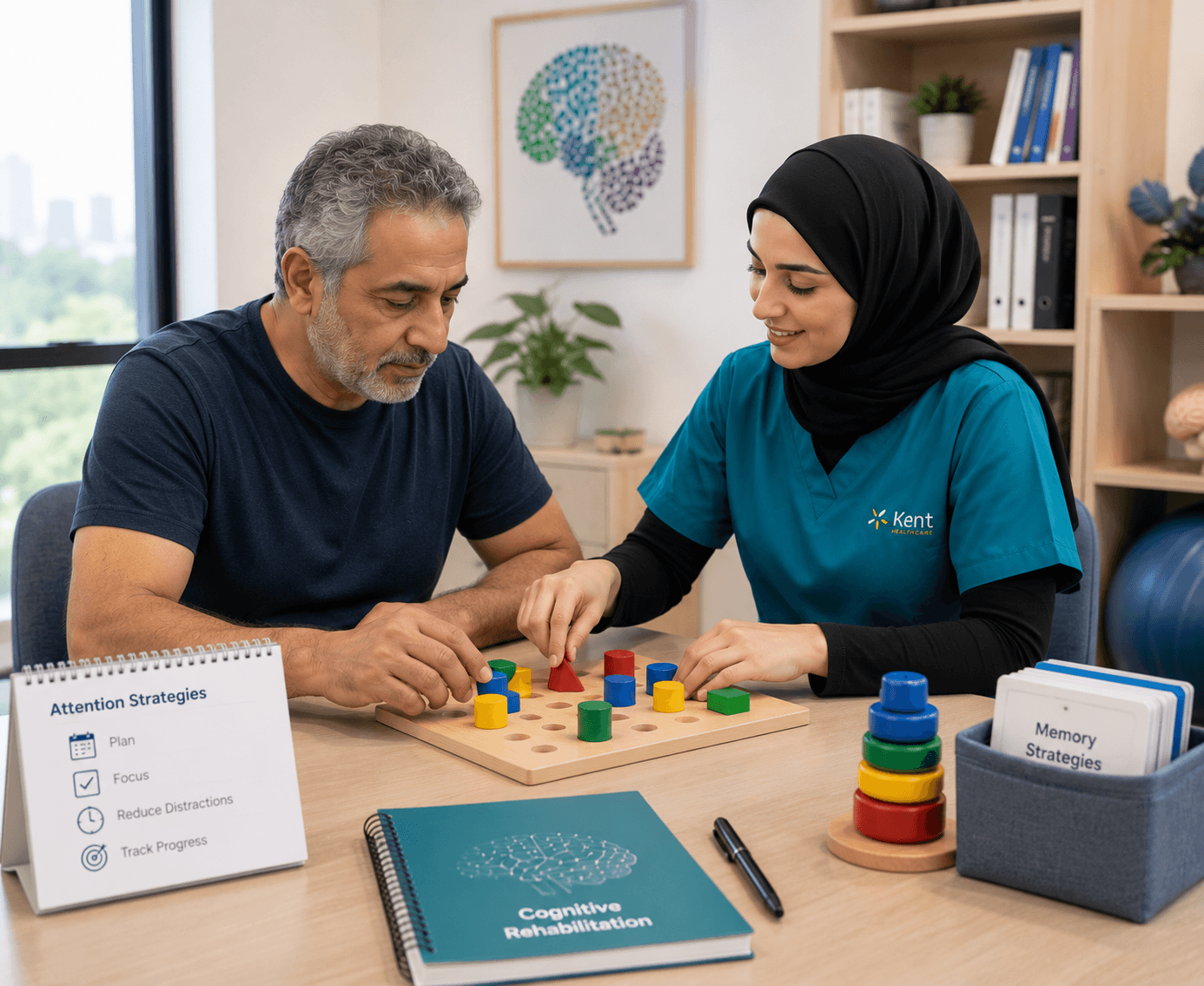
Cognitive changes after a stroke or brain injury are often the most disabling consequences—yet they're frequently the least addressed. Physical rehabilitation gets attention; cognition often doesn't. Structured cognitive rehabilitation produces measurable improvement in attention, memory, executive function, and daily function. This is what our Cognitive Recovery Pathway is built around.
What we work on
- Attention: Sustained, selective, divided, and alternating
- Working memory and executive function: Planning, organization, decision-making, and problem-solving
- Processing speed
- Long-term memory and learning strategies
- Awareness and insight (often impaired after frontal-lobe injury)
- Cognitive-communication difficulties
- Behavioral and emotional changes secondary to brain injury
- Return-to-work and return-to-study planning, where applicable
Our approach
Comprehensive neuropsychological assessment at baseline to identify the specific cognitive profile—what's affected, what's preserved, what's modifiable. A structured rehabilitation program combining direct cognitive remediation (targeted exercises), compensatory strategy training (external aids, routines, environmental modifications), and metacognitive training (awareness and self-monitoring). Coordination with the patient's neurological rehabilitation team—physiotherapy, occupational therapy, speech-language therapy—to align cognitive and physical goals.
Outcome measures we use
- Repeatable Battery for the Assessment of Neuropsychological Status (RBANS)
- Behavioral Assessment of the Dysexecutive Syndrome (BADS)
- Rivermead Behavioral Memory Test
- Trail Making Test
- Test of Everyday Attention
- Functional Outcome Measures Relevant to the Patient's Goals
Who leads this work at Kent
Cognitive rehabilitation at Kent is led by Arshiya Noora, working in coordination with the Neurological rehabilitation team.
Frequently asked questions
When should cognitive rehabilitation start?
As soon as the patient is medically stable and able to engage. Earlier work is better—particularly for awareness and insight issues, which are easier to address when the brain is still in an active recovery phase.
Will my memory come back to what it was?
Depends on the injury — severity, location, time since injury, age. Most patients with appropriate cognitive rehabilitation see meaningful improvement; many achieve substantial recovery; some have lasting cognitive differences.Expert individual assessment is more useful than generic answers.
What's the difference between cognitive rehabilitation and brain training apps?
Brain training apps mostly improve performance on the specific tasks they train—that improvement rarely transfers to real-world function. Cognitive rehabilitation is designed around the patient's specific real-world goals (returning to work, managing daily life, remembering appointments) with strategies that transfer.
How long does cognitive rehabilitation take?
Typically 12–24 weeks of structured work, 1–2 sessions per week, often longer for severe injuries. Many patients return for periodic blocks years after the original injury, particularly when life circumstances change (new job, return to study, etc.).
Do you work with patients who are still seeing a neurologist?
Yes, and we strongly prefer it. We send written progress reports and coordinate with the patient's neurology team throughout.