
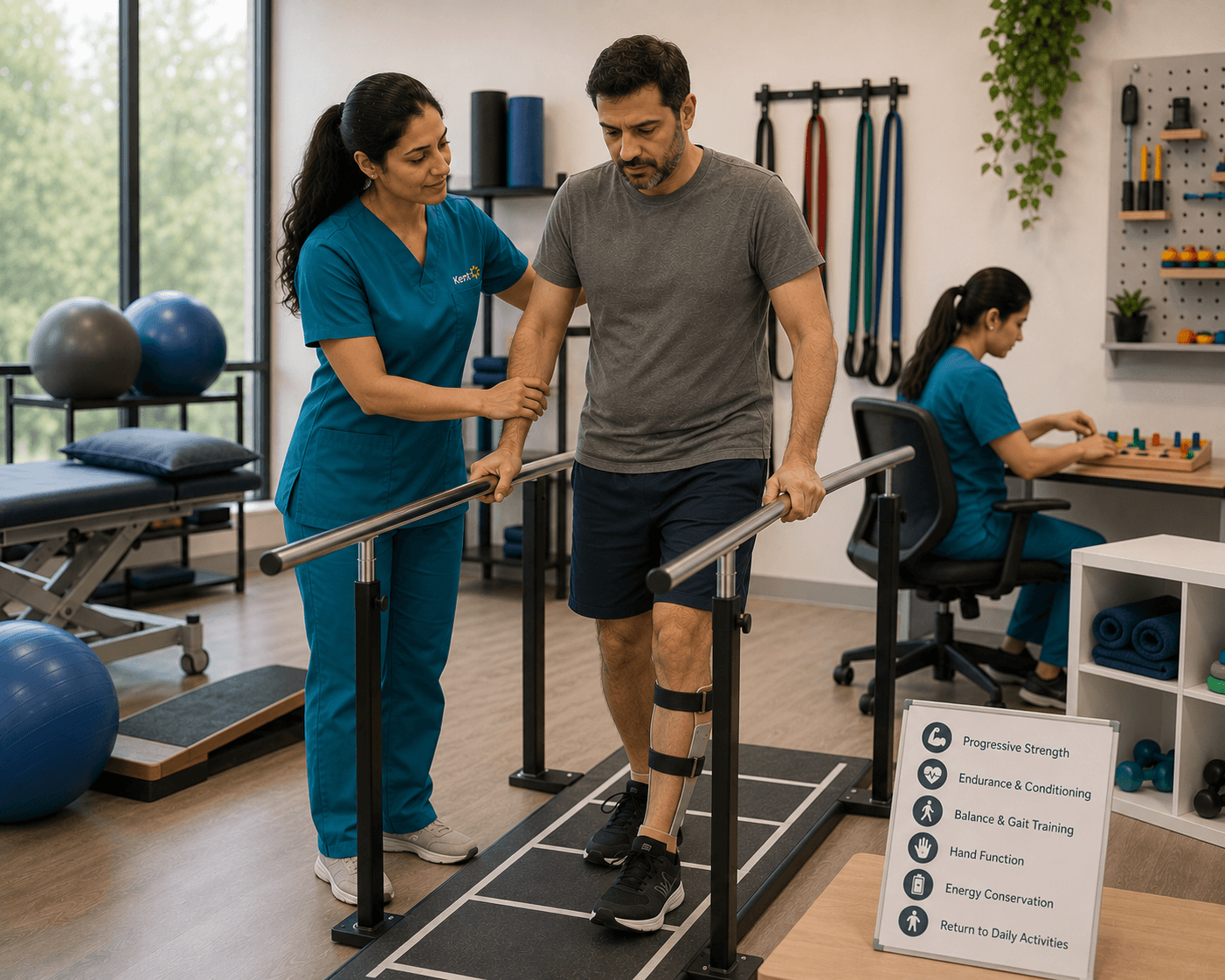
GBS recovery is one of the most rewarding areas of neurological rehabilitation because most patients recover substantially over time—but the recovery is gradual, often takes 12–24 months, and is significantly accelerated by structured therapy. The early weeks after acute medical treatment focus on preventing contractures; the months that follow focus on rebuilding strength, endurance, and function progressively.
What GBS rehabilitation involves
Progressive strength training in returning muscle groups. Range of motion and contracture prevention. Endurance and cardiovascular reconditioning—GBS deconditions patients severely. Gait re-training and balance work. Hand function and fine motor work. Energy conservation and fatigue management—fatigue often persists long after strength returns. Return-to-work planning. Where significant residual weakness remains, adaptive equipment and home modification.
Pacing the program
GBS rehabilitation requires careful dosing—too little misses recovery opportunities; too much risks setbacks. Sessions are scheduled in patterns that respect fatigue and the slow, progressive nature of nerve regeneration. We typically see patients two to three times weekly in the active recovery phase, tapering as function returns.
Outcome measures we use
- GBS Disability Score
- Overall Disability Sum Score (ODSS)
- Manual Muscle Testing
- Berg Balance Scale
- 6-Minute Walk Test
- 10-Metre Walk Test
- Fatigue Severity Scale
- Functional Independence Measure (FIM)
Who leads this work at Kent
GBS rehabilitation at Kent is led by Aleena Mathew within the Neurological Rehabilitation Practice.
Frequently asked questions
When should GBS rehabilitation start?
As soon as the patient is medically stable, often while still in hospital. The early weeks are critical for contracture prevention; the months that follow are when most of the strength and function returns.
How long does GBS recovery take?
Variable. Most patients see significant improvement over 6–12 months, with continuing slow improvement for up to 2 years. A minority have lasting residual weakness.
What about CIDP?
Chronic inflammatory demyelinating polyneuropathy is managed by neurology with immunomodulating therapy. Rehabilitation supports function alongside medical treatment and is typically intermittent and long-term.
Will the patient walk again?
Most GBS patients regain walking. For some, it returns to pre-illness levels; for others, residual weakness or fatigue means walking is more limited. Realistic expectations come from accurate clinical assessment, not from generic statistics.