
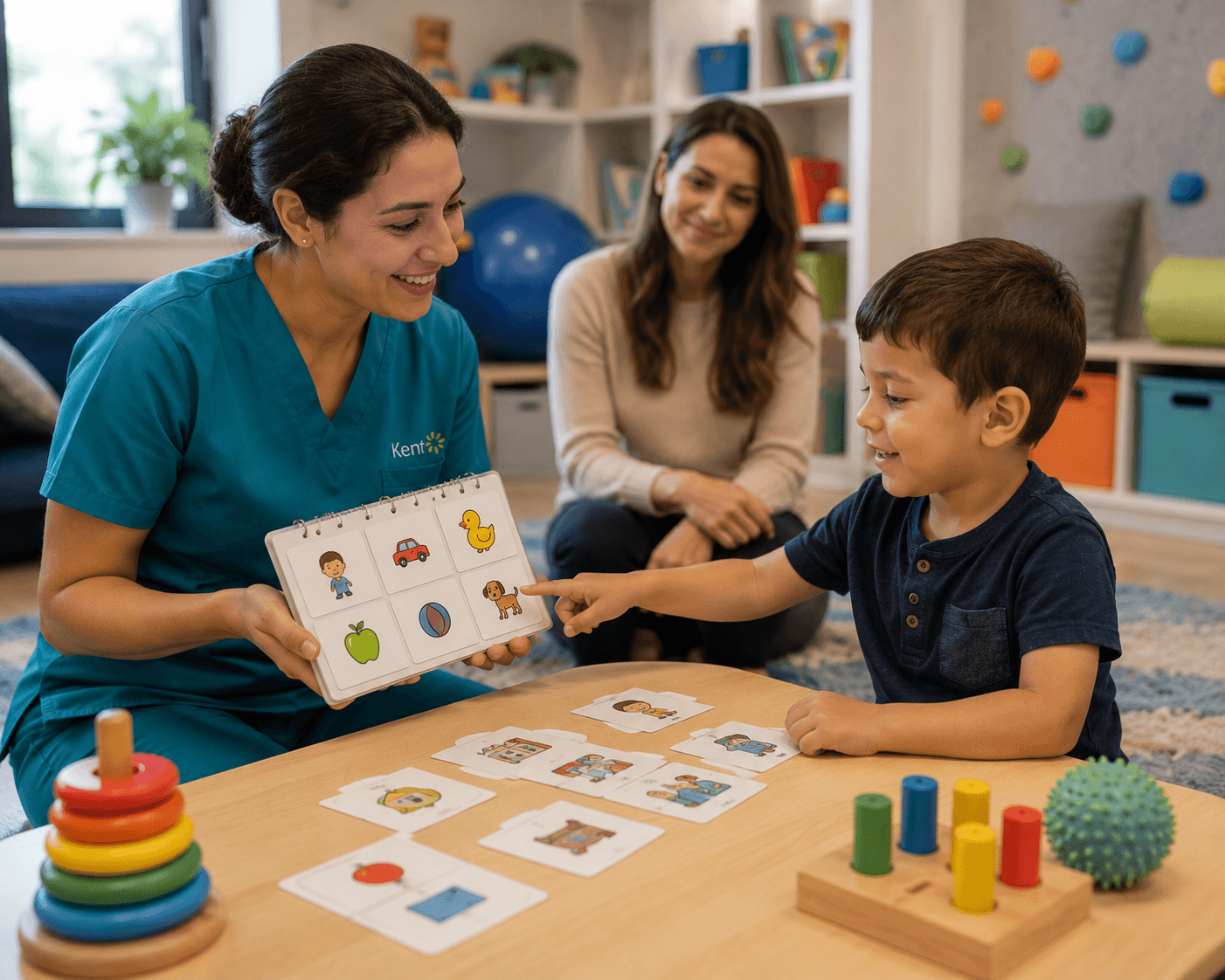
Autism support at Kent means individual, family-centred therapy that helps autistic children communicate, regulate, and play in ways that work for them, with a formal diagnosis welcome but not required to begin.
Most children referred to Kent for autism support are between two and twelve years old. Some arrive with a diagnosis from a developmental pediatrician. Others come with concerns about communication, social interaction, sensory regulation, or play, and need an autism assessment before therapy can begin. We work with families at both points in the journey.
Early signs of autism in children
- Communication: late or limited speech, not responding to their name, little pointing or gesturing
- Social interaction: limited eye contact, less interest in other children, difficulty sharing attention
- Play and behavior: repetitive movements, strong need for routine, a narrow set of interests
- Sensory: strong reactions to sounds, textures, lights, or food
These signs vary widely between children. If you notice several of them, a developmental assessment is the right next step.
What autism support looks like at Kent
- Speech-language therapy for communication: verbal language for some children, AAC (augmentative and alternative communication) for others.
- Occupational therapy for sensory regulation, daily routines, and play skills.
- Sensory integration therapy in our purpose-built sensory gym.
- Family coaching, because the strongest predictor of pediatric therapy outcomes is what happens between sessions, not in them.
- Developmental psychology for behavioral and emotional support.
- Pediatric neuropsychological assessment where the diagnostic picture is unclear or a formal assessment is needed for school.
Our program
Pathway to Progress: Autism Support
A structured multidisciplinary program coordinating speech-language therapy, occupational therapy, sensory integration, and family coaching across a 12-week block. Session count, frequency, and discipline mix are individualized to the child after a full pediatric assessment.
Why we don't do ABA
Our pediatric team is developmental and relationship-based. We believe the best outcomes for many autistic children come from approaches that build communication, regulation, and play skills through naturalistic interaction, with families as partners. ABA is one approach among several, and where it is specifically indicated for a particular child, we refer to specialist ABA providers who deliver it well. We don't pretend to do everything; we do what we do, well.
Outcome measures we use
- Vineland Adaptive Behavior Scales
- Sensory Profile-2
- CELF-5 / Preschool Language Scales
- Social Communication Questionnaire
- Parent-Reported Developmental Milestones
- Goal Attainment Scaling
About the clinician: my journey in autism support
Autism support at Kent is led by the pediatric team, with Ayingbee Kakchingtabam, pediatric OT/SLP, working alongside speech-language pathologists and family coaches at Kent Healthcare, Bur Dubai.
[ADD in first person: qualifications, years working with autistic children, why you chose a developmental, non-ABA approach, and what families can expect.]
Meet the Kent team · Related: speech delay, developmental delay, sensory processing therapy
Frequently asked questions
My child hasn't been diagnosed but I have concerns. Can you help?
Yes. You don't need a formal diagnosis to start. We assess your child, identify the support they need, and begin therapy where appropriate. If formal diagnosis is needed, we coordinate with a developmental pediatrician.
At what age should we start?
As early as concerns appear. Early intervention is one of the strongest predictors of long-term outcomes for autistic children. We assess infants and toddlers regularly. If you're noticing differences and you're not sure, book an assessment and we will give you an expert read.
Will my child be in therapy forever?
No. Goals are reviewed every 12 weeks. Some children need intensive support for one or two years and then move into school with periodic check-ins. Others continue across school years working on specific developmental targets. We share the trajectory with families openly.
Will the therapy change who my child is?
No. The goal of autism support at Kent is to help your child communicate, regulate, and engage in ways that work for them, not to make them "less autistic." We support neurodivergent identity. We work on the skills that make daily life easier.
Do you do ABA?
No. Our approach is developmental and relationship-based, combining speech-language therapy, occupational therapy, sensory integration, and family coaching. Where ABA is specifically indicated, we refer to specialist ABA providers.
Will my child be in a group or one-to-one?
Almost always one-to-one with parent inclusion. Group sessions are added for specific goals (social skills, group play) for some children once individual goals are progressing.
Do you coordinate with schools?
Yes, with parental consent. We provide written reports, attend school meetings where useful, and coach teachers on specific strategies. School consistency is essential for autistic children.