
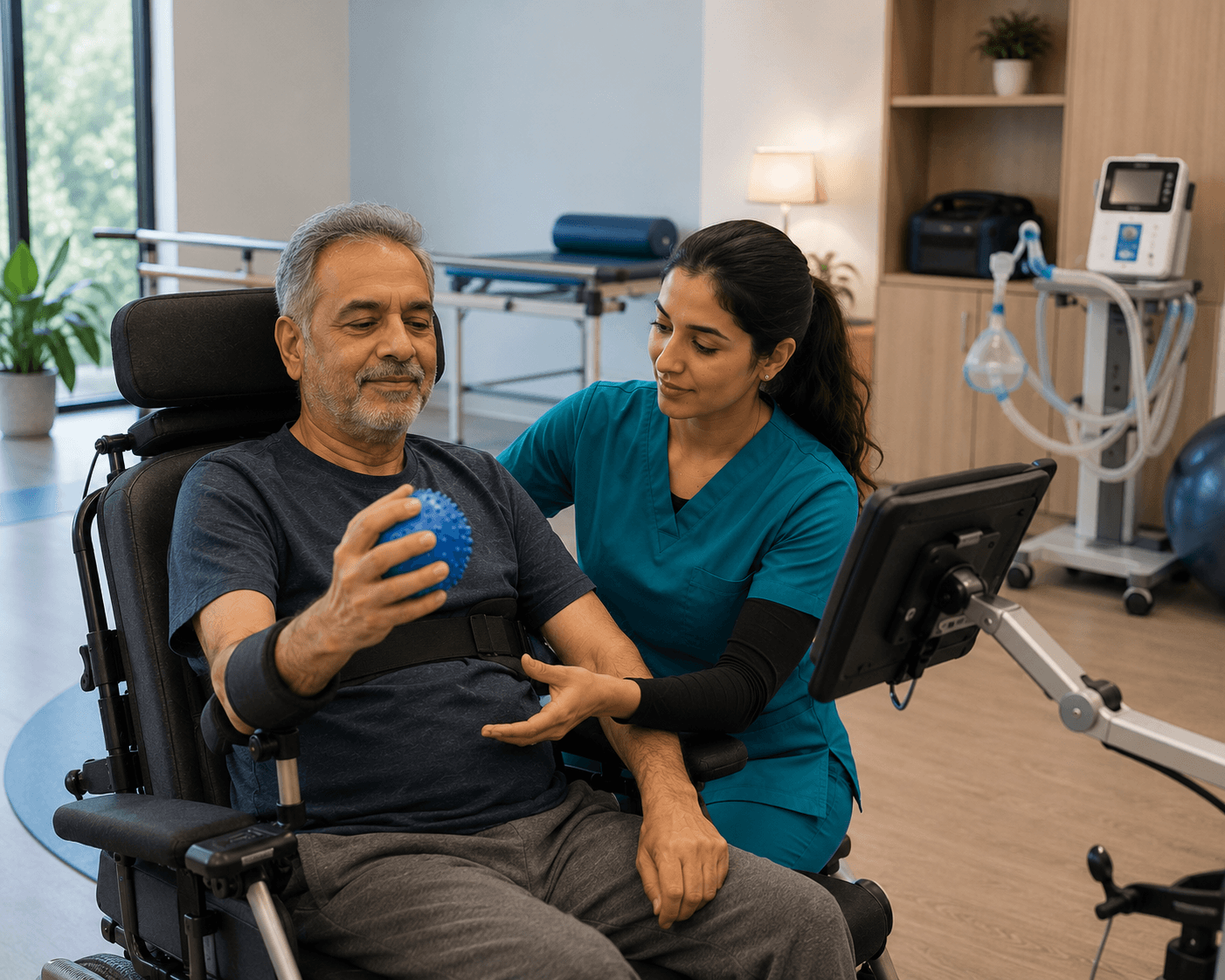
MND rehabilitation is fundamentally different from rehabilitation for conditions where recovery is the goal. The work is about maintaining function, slowing decline where possible, preventing secondary problems, and adapting capability as the disease progresses. Anticipation is the most important clinical skill — we plan for what's coming, not just what's present.
What MND rehabilitation involves
Rehabilitation emphasizes mobility maintenance through tailored exercise, gait support, fall prevention, and adaptive equipment, while supporting upper-limb function for daily tasks. Speech therapy transitions to augmentative and alternative communication (AAC) as speech changes. Swallowing management includes diet texture modification, aspiration monitoring, and gastroenterology coordination for feeding tube planning. Additionally, care covers respiratory monitoring for non-invasive ventilation, adaptive equipment provision, home modifications, caregiver training, and end-of-life planning integrated with palliative care.
Working with the wider team
MND patients typically work with neurology, respiratory medicine, gastroenterology (for feeding tube decisions), and palliative care. Rehabilitation sits in the middle of this team. We send progress reports to all involved clinicians, attend multidisciplinary meetings where useful, and integrate our work with the rest of the patient's care plan.
Outcome measures we use
- ALSFRS-R (Amyotrophic Lateral Sclerosis Functional Rating Scale-Revised)
- Forced Vital Capacity (with respiratory medicine)
- Speech Intelligibility Test
- Penetration-Aspiration Scale
- Manual Muscle Testing
Who leads this work at Kent
MND care at Kent is led by Anjali Kuriakose, working with speech-language pathology for communication and swallowing, occupational therapy for daily activities, and physiotherapy for mobility maintenance.
Frequently asked questions
When should rehabilitation start for MND?
At diagnosis. Anticipatory care is the most effective approach — establishing baseline function, planning for change, and building relationships before crises emerge. Don't wait for significant decline.
Will rehabilitation slow disease progression?
No, rehabilitation does not change the underlying disease. But it consistently preserves function for longer, prevents secondary problems, and improves quality of life throughout the disease course.
What about exercise — is it safe in MND?
Appropriate, low-impact exercise is safe and beneficial for most MND patients. The dosing is critical — avoiding excessive fatigue and over-exertion of weakening muscles. We prescribe exercise individually.
Do you work with families and caregivers?
Yes, extensively. Caregiver training is part of every MND program — safe handling, transfers, feeding support, equipment use, and recognising warning signs.
Can you visit at home?
Yes. As MND progresses, clinic attendance often becomes impractical. Kent at Home delivers therapy and equipment training at the patient's address.