
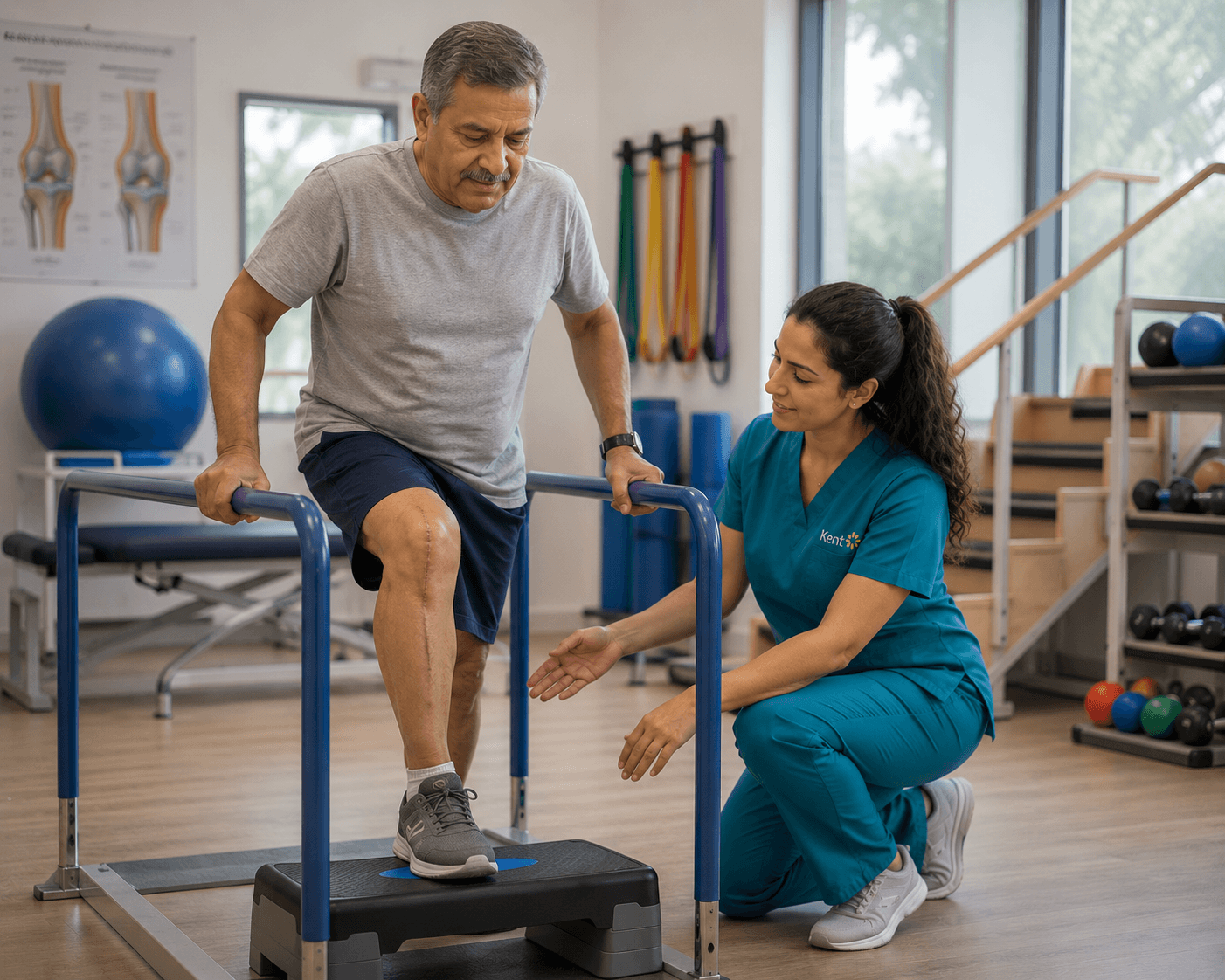
Knee replacement rehabilitation is more time-sensitive than hip rehabilitation. The early weeks must restore range of motion before scar tissue limits it; the months that follow must rebuild strength and confidence. Structured, intensive early rehabilitation produces measurably better outcomes than ad-hoc therapy.
What the program covers
The program focuses on pain and swelling management alongside range-of-motion work—prioritizing full extension in the initial weeks and progressing flexion across 12 weeks. Rehabilitation includes quadriceps activation, strengthening, and gait retraining with progressive reduction of assistive devices. Additionally, therapy addresses balance, proprioception, and functional tasks (such as stairs, sit-to-stand, and kneeling where permitted), alongside safe return to driving (typically 6 weeks) and recreational activities.
Manipulation under anesthesia—when and why
A small proportion of TKR patients don't gain adequate flexion despite good rehabilitation and may need manipulation under anaesthetic (MUA) at the 8–12 week mark. We monitor closely for this and refer back to your surgeon promptly if it appears needed. Catching this early matters.
Working with your surgeon
We follow your surgeon's specific protocol. We send written progress reports at weeks 6 and 12 and refer back promptly for anything concerning. For patients with multiple joint replacements or complex revision surgeries, we coordinate more closely throughout.
Outcome measures we use
- Knee Injury and Osteoarthritis Outcome Score (KOOS)
- Oxford Knee Score
- Visual Analog Scale
- Knee Range of Motion (flexion and extension)
- Timed Up and Go
- 6-Minute Walk Test
- 30-Second Sit-to-Stand
- Quadriceps Strength Testing
Who leads this work at Kent
Post-knee replacement rehabilitation at Kent is delivered by Vishakha Kadam, senior physiotherapists with specific training in orthopedic and post-surgical rehabilitation.
Frequently asked questions
How quickly should I bend my knee after surgery?
Range of motion targets are set by your surgeon and your physiotherapist together. Most protocols aim for full extension by 2–4 weeks and 90+ degrees of flexion by 6 weeks, working toward 120+ degrees by 12 weeks. We work intensively on this early.
Will the knee replacement still hurt during rehabilitation?
Yes, particularly in the first 6 weeks. Knee replacement rehabilitation involves working through some discomfort—but there's a difference between productive discomfort and harmful pain, and we coach you on the difference.
How long until I can walk normally?
Most patients walk independently without aids by 6–8 weeks and walk near-normally by 12–16 weeks. Higher-level function continues to improve for 6–12 months.
What about kneeling—will I be able to kneel again?
Many patients can kneel after TKR; many find it persistently uncomfortable. The ability to kneel depends partly on the surgical approach and partly on rehabilitation. We work on this if it's a goal.
Can I have rehabilitation at home?
Yes, particularly in the first 2–4 weeks. Kent at Home delivers post-TKR rehabilitation across Dubai, Sharjah, and Ajman. Most patients transition to clinic-based therapy once mobility allows.