
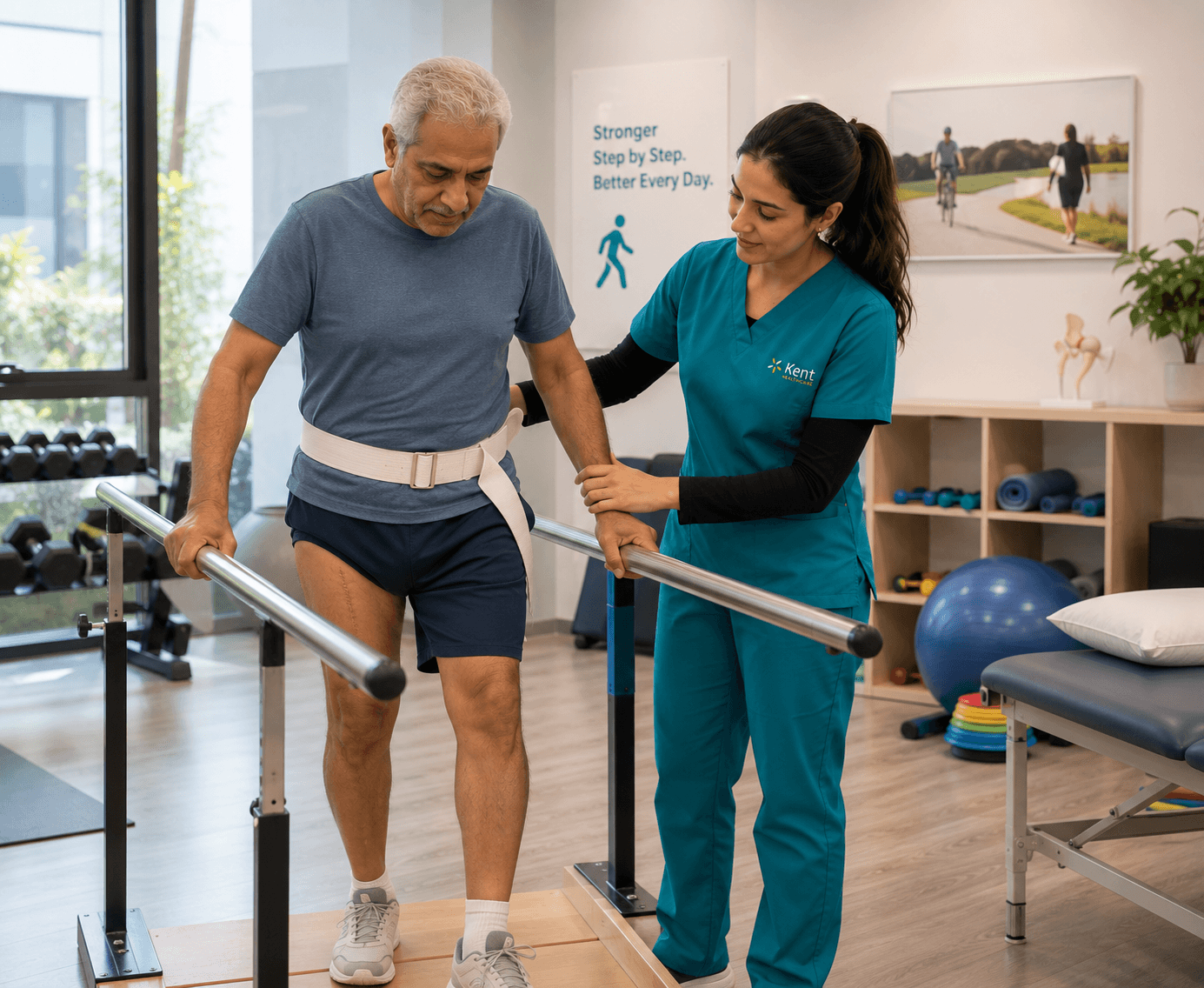
The surgical result depends partly on the surgeon and partly on the rehabilitation that follows. Without structured rehabilitation, hip replacements heal, but they don't fully restore function. With it, most patients return to higher levels of activity than they had before the surgery. The first 12 weeks set the trajectory.
What the program covers
The program focuses on pain and swelling management alongside early mobility and gait training with appropriate aids. Exercises preserve hip range of motion within surgeon-specified precautions while progressively strengthening the gluteals, quadriceps, and core. Additionally, therapy incorporates balance, proprioception, stair training, and guidance on returning to driving (typically 4–8 weeks), recreational activities (walking, cycling, swimming), and sport-specific programming.
Working with your surgeon
We follow your surgeon's specific protocol — anterior approach hip replacements have different early restrictions than posterior approach. Cemented vs uncemented implants have different weight-bearing progressions. We send written progress reports at the end of weeks 6 and 12, and refer back promptly if we notice anything concerning.
Typical timeline
Most patients see significant functional gain across 6–12 weeks of structured rehabilitation, 2–3 sessions per week. Beyond 12 weeks, many patients continue with a maintenance program independently or return for periodic check-ins. Higher-level return to recreational activity or sport typically takes 4–6 months.
Outcome measures we use
- Hip Disability and Osteoarthritis Outcome Score (HOOS)
- Oxford Hip Score
- Visual Analog Scale
- Timed Up and Go
- 10-Metre Walk Test
- 30-Second Sit-to-Stand
- Hip Range of Motion(goniometry)
Who leads this work at Kent
Post-hip replacement rehabilitation at Kent is delivered by Tresha Parmar, senior physiotherapists with specific training in orthopedic and post-surgical rehabilitation.
Frequently asked questions
When should rehabilitation start after my hip replacement?
Often before the surgery (prehabilitation) and then within days of the operation. Most patients begin physiotherapy in hospital and continue with outpatient or home physiotherapy from the first week. Earlier structured rehabilitation produces better long-term results.
How many sessions will I need?
Typically 18–30 sessions over 8–12 weeks (2–3 sessions per week). Frequency and total volume depend on your surgical approach, pre-surgery condition, and goals.
Will I be able to do everything I did before?
Most patients return to pre-surgery activity levels and often beyond—many do so within 6 months. Higher-impact activities (running, contact sport) are usually discouraged after THR; lower-impact activities (walking, cycling, swimming, golf) are typically encouraged.
I had my hip replaced years ago and it still doesn't feel right — can you help?
Yes. Many post-THR patients have residual weakness, gait abnormalities, or pain patterns that respond to a structured rehabilitation block years after the surgery.
Do you offer home physiotherapy after hip replacement?
Yes. Many patients start with home-based therapy in the first two to four weeks and transition to clinic when mobility allows.