
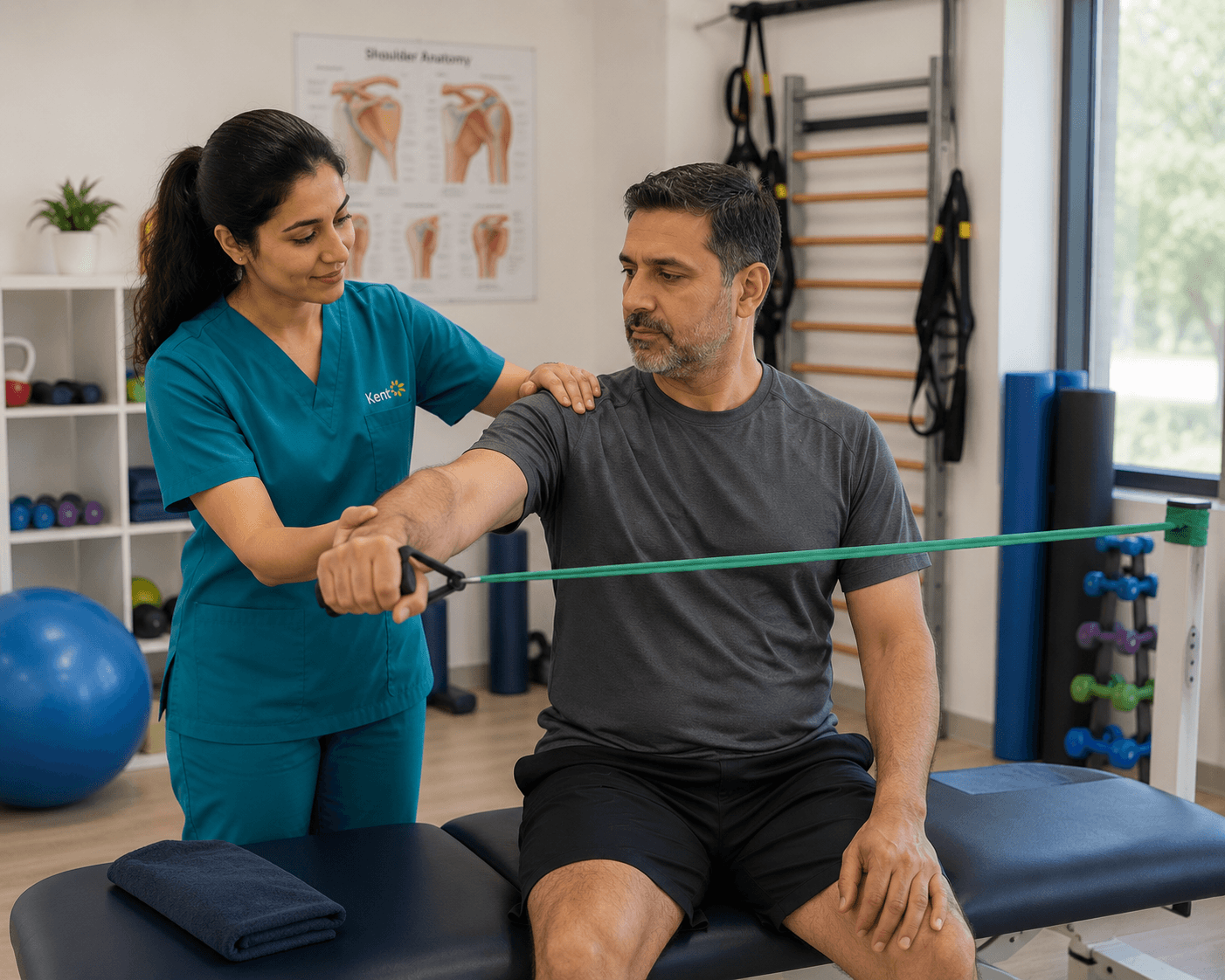
Shoulder rehabilitation is unique among joints because the early weeks after rotator cuff repair must restrict movement to protect the repair, while the later weeks must restore full motion before stiffness develops. Getting this transition right is the central technical challenge. Following the surgeon's protocol rigorously—not improvising—is what protects the surgical result.
Post-rotator cuff repair rehabilitation
- Phase 1 (Weeks 0–6)-Protected Motion: Sling protection per surgeon protocol, pendulum exercises, passive range of motion within strict limits, and scapular setting.
- Phase 2 (Weeks 6–12) - Active Motion: Gradual progression to active range of motion, posture training, and light strengthening of unaffected musculature.
- Phase 3 (Months 3–6) - Strengthening: Progressive rotator cuff and scapular strengthening alongside functional reach activities.
- Phase 4 (Months 6+) - Return to Function: Advanced sport-specific or work-specific progressions where applicable.
Conservative treatment of rotator cuff tendinopathy
Many rotator cuff problems do not need surgery. Structured rehabilitation—progressive loading of the rotator cuff and scapular stabilisers, manual therapy where indicated, posture work, education on activity modification—resolves a substantial proportion of presentations. We provide an expert read at assessment on whether surgical referral is needed or whether conservative work is the right path.
Post-arthroscopic shoulder surgery
Labral repairs, SLAP repairs, Bankart repairs, biceps tenodesis—each surgical procedure has its own rehabilitation protocol. We work to the surgeon's specific protocol and adjust the progression to the individual patient's healing.
Outcome measures we use
- DASH (Disabilities of the Arm, Shoulder and Hand)
- Constant-Murley Score
- American Shoulder and Elbow Surgeons (ASES) Score
- Shoulder Pain and Disability Index (SPADI)
- Visual Analogue Scale
- Range of Motion
- Strength Testing
Who leads this work at Kent
Shoulder rehabilitation at Kent is delivered by senior physiotherapists Mohammed Jamsheer TPMwith specific training in upper-limb orthopedic rehabilitation.
Frequently asked questions
When can I take the sling off after rotator cuff repair?
Per your surgeon's protocol—typically between 4 and 6 weeks for most repairs, longer for large or revision repairs. We follow the surgeon's instructions strictly. Removing the sling too early is a re-tear risk.
How long until my shoulder is back to normal after rotator cuff repair?
Most patients are functionally usable by 3–4 months and continue to improve for 9–12 months. Heavy lifting and overhead sports typically take 6+ months.
Can I avoid rotator cuff surgery with physiotherapy alone?
Often yes, particularly for partial tears, age-related degenerative changes, and small tears in patients with low functional demands. The evidence supports a trial of structured rehabilitation before surgery for many patients.
What about frozen shoulder?
Frozen shoulder (adhesive capsulitis) is a separate condition with its own rehabilitation approach — see our frozen shoulder page.
I had shoulder surgery and still can't lift my arm overhead—can you help?
Yes. Post-surgical shoulder stiffness or weakness years after surgery responds to structured rehabilitation in most cases.