
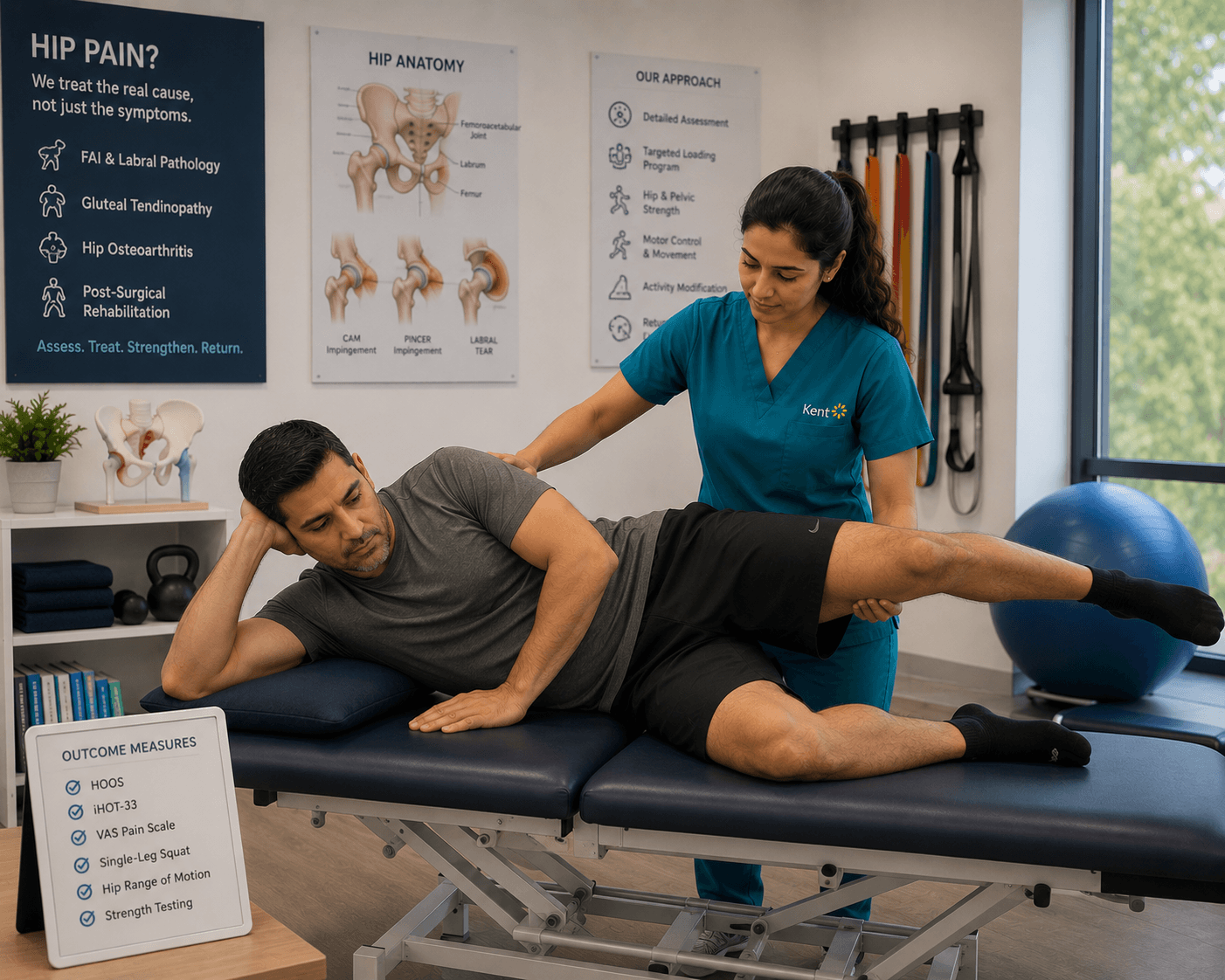
Hip pain in active adults under 50 is most commonly caused by FAI, labral pathology, or gluteal tendinopathy—conditions that respond well to structured rehabilitation in many cases, and that need careful assessment to determine whether surgery is the right next step. The difference between rehabilitation-responsive and surgery-needing hips is determined by the specific anatomy and symptom pattern, not by imaging alone.
What we treat
We treat femoroacetabular impingement (FAI—cam, pincer, or mixed) and acetabular labral pathology. Our practice manages gluteal tendinopathy, greater trochanteric pain syndrome, and non-surgical hip osteoarthritis. We provide post-operative rehabilitation for hip arthroscopy and hip replacement, alongside care for post-traumatic hip pain. Additionally, we treat sports-related hip and groin pain, including adductor-related, iliopsoas-related, and pubic-related conditions.
Our approach
Detailed assessment to identify the specific cause of hip pain—symptom pattern, special tests, movement analysis. A structured rehabilitation program—typically a 12-week structured loading program for FAI and labral problems, focusing on hip and pelvic strength, motor control, and progressive return to function. Manual therapy where indicated. Education on activity modification. Coordination with hip surgeons when surgical opinion is indicated.
Outcome measures we use
- Hip Disability and Osteoarthritis Outcome Score (HOOS)
- International Hip Outcome Tool (iHOT-33)
- Visual Analogue Scale
- Single-Leg Squat Assessment
- Hip range of motion
- Strength Testing
Who leads this work at Kent
Hip pain treatment at Kent is delivered by Vishakha Kadam senior physiotherapist with specific orthopedic and sports rehabilitation training.
Frequently asked questions
My MRI shows a labral tear—do I need surgery?
Not necessarily. Many labral tears are asymptomatic; many symptomatic labral tears improve with structured rehabilitation. Decisions about surgery are based on the specific symptom pattern, functional impact, and response to a trial of rehabilitation—not on imaging alone.
What is FAI?
Femoroacetabular impingement is a condition where the shape of the ball (femoral head) or socket (acetabulum) causes abnormal contact during hip movement. It's a common cause of hip pain in active adults and is responsible for many cases of labral pathology. It often responds to structured rehabilitation; some cases benefit from surgery.
I've been told I have bursitis on the side of my hip—is that the same as gluteal tendinopathy?
Often it's the same problem with a different name. What was traditionally called "trochanteric bursitis" is now usually understood as gluteal tendinopathy. The treatment is progressive tendon loading, not rest and ice.
I had hip arthroscopy—when should I start rehabilitation?
Within days to weeks of surgery, per your surgeon's protocol. Post-arthroscopy rehabilitation is a structured 4–6 month program. Part E—Pediatric Conditions (5 pages) Five condition pages for the Pediatric Neurodevelopment practice. Each page is written for parents—clinically accurate but emotionally accessible—and supports both formally diagnosed referrals and self-referring families with concerns.