
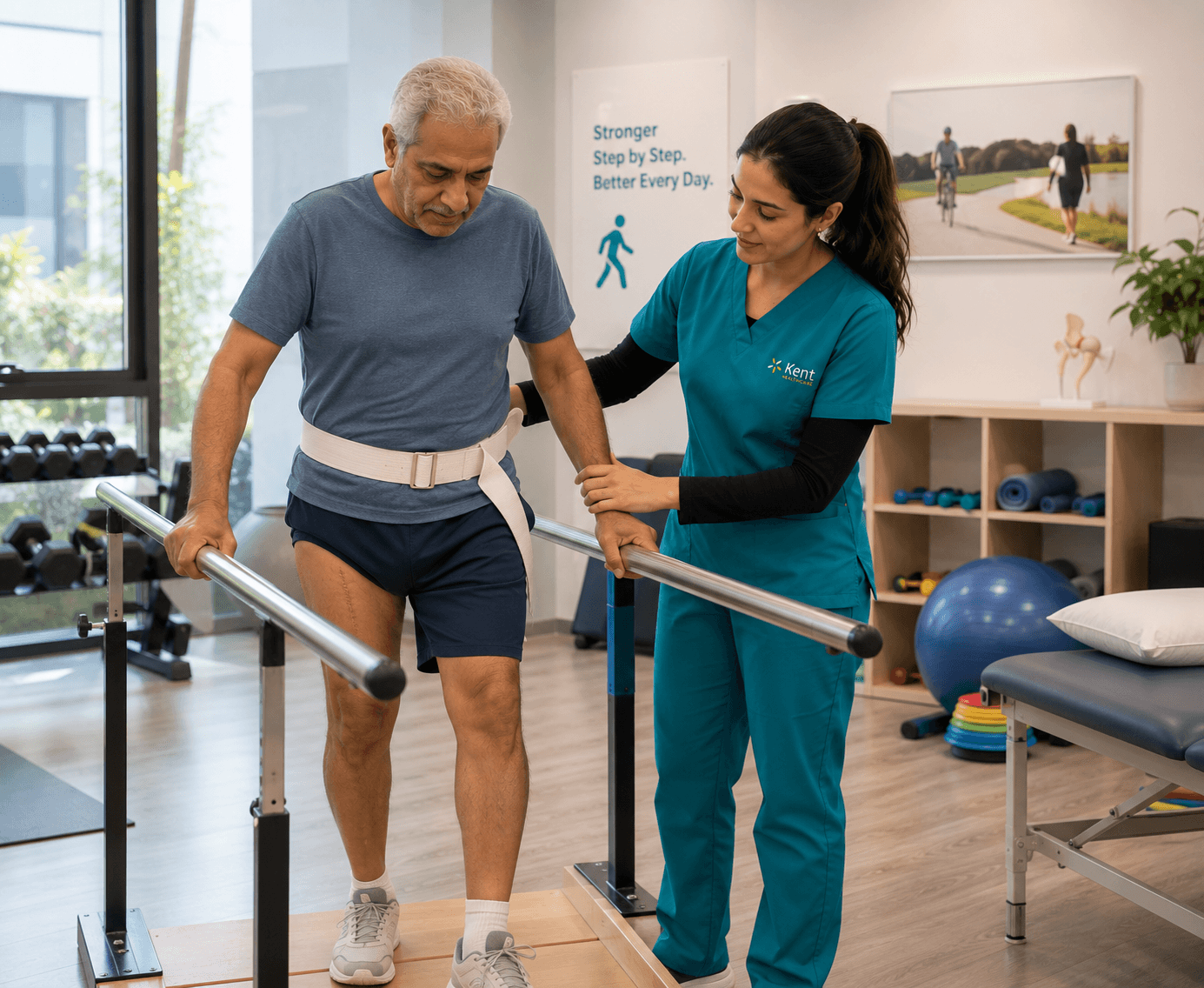
Hip replacement rehabilitation is a structured, surgeon-coordinated physiotherapy program, usually 6 to 12 weeks, that restores walking, strength, and function after surgery and sets the trajectory for long-term recovery.
The surgical result depends partly on the surgeon and partly on the rehabilitation that follows. Without structured rehabilitation, hip replacements heal, but they don't fully restore function. With it, most patients return to their previous activity levels, and many exceed them. The first 12 weeks set the trajectory.
What the hip replacement rehabilitation program covers
- Pain and swelling management alongside early mobility and gait training with appropriate aids.
- Exercises that preserve hip range of motion within surgeon-specified precautions while progressively strengthening the gluteals, quadriceps, and core.
- Balance, proprioception, and stair training.
- Guidance on returning to driving (typically 4–8 weeks, once your surgeon agrees), recreational activities (walking, cycling, swimming), and sport-specific programming.
Working with your surgeon
We follow your surgeon's specific protocol. Anterior approach hip replacements have different early restrictions than posterior approach, and cemented and uncemented implants have different weight-bearing progressions. We send written progress reports at the end of weeks 6 and 12, and refer back promptly if we notice anything concerning.
Hip replacement recovery timeline
Most patients see significant functional gain across 6–12 weeks of structured rehabilitation, 2–3 sessions per week. Beyond 12 weeks, many patients continue with a maintenance program independently or return for periodic check-ins. Higher-level return to recreational activity or sport typically takes 4–6 months.
Outcome measures we use
- Hip Disability and Osteoarthritis Outcome Score (HOOS)
- Oxford Hip Score
- Visual Analog Scale
- Timed Up and Go
- 10-Metre Walk Test
- 30-Second Sit-to-Stand
- Hip Range of Motion (goniometry)
About the clinician: my journey in hip replacement rehabilitation
Post-hip replacement rehabilitation at Kent is delivered by Tresha Parmar, senior physiotherapist with specific training in orthopedic and post-surgical rehabilitation, in the Movement practice at Kent Healthcare, Bur Dubai.
[ADD in first person: qualifications and orthopedic training, years treating hip replacement patients, the surgical approaches and surgeons you work with, and why you do this work.]
Meet the Kent team · Related: post-knee replacement rehabilitation, post-ACL rehabilitation
Frequently asked questions
How long is recovery after a hip replacement?
Most patients see significant functional gain across 6 to 12 weeks of structured rehabilitation, with 2 to 3 sessions per week. Returning to higher-level recreational activity typically takes 4 to 6 months.
What are hip precautions after hip replacement surgery?
Precautions depend on your surgical approach. Anterior approach replacements have different early restrictions than posterior approach, and cemented and uncemented implants have different weight-bearing progressions. We follow your surgeon's specific protocol.
When can I drive after hip replacement surgery?
Return to driving is typically 4 to 8 weeks after surgery, once your surgeon agrees and you can control the car safely.
What exercises help after a hip replacement?
Exercises protect hip range of motion within your surgeon's precautions while progressively strengthening the gluteals, quadriceps, and core, with balance, proprioception, and stair training added as you progress.
When should I contact my surgeon urgently after hip replacement?
Contact your surgeon or seek urgent care for fever, spreading redness or discharge at the wound, calf pain or swelling, sudden severe pain, or inability to bear weight on the leg.
When should rehabilitation start after my hip replacement?
Often before the surgery (prehabilitation) and then within days of the operation. Most patients begin physiotherapy in hospital and continue with outpatient or home physiotherapy from the first week. Earlier structured rehabilitation produces better long-term results.
How many sessions will I need?
Typically 18–30 sessions over 8–12 weeks (2–3 sessions per week). Frequency and total volume depend on your surgical approach, pre-surgery condition, and goals.
Will I be able to do everything I did before?
Most patients return to pre-surgery activity levels, and many exceed them, often within 6 months. Higher-impact activities (running, contact sport) are usually discouraged after THR; lower-impact activities (walking, cycling, swimming, golf) are typically encouraged. Follow your surgeon's advice.
I had my hip replaced years ago and it still doesn't feel right. Can you help?
Yes. Many post-THR patients have residual weakness, gait abnormalities, or pain patterns that respond to a structured rehabilitation block years after the surgery.
Do you offer home physiotherapy after hip replacement?
Yes. Many patients start with home-based therapy in the first two to four weeks and transition to clinic when mobility allows.