
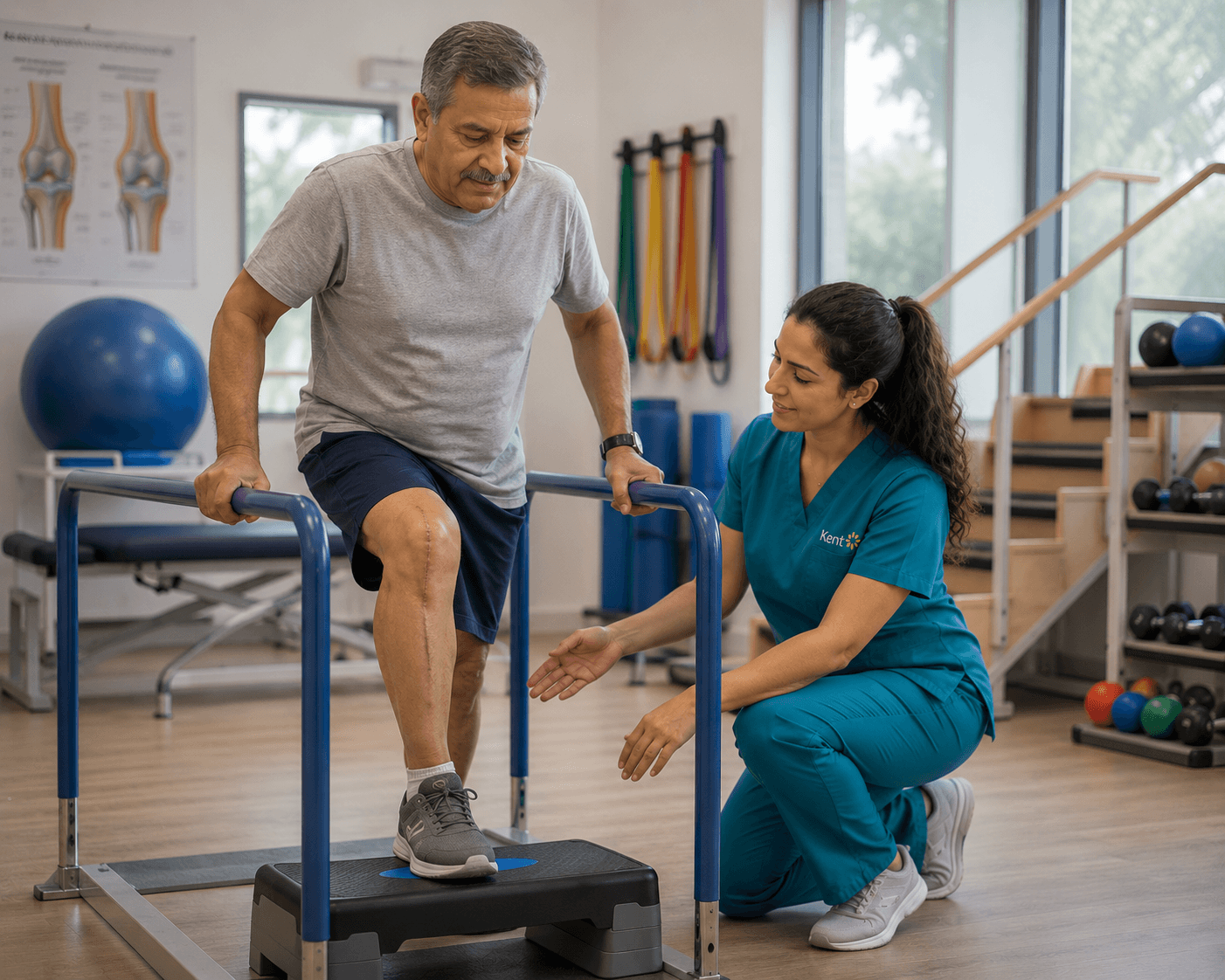
After a knee replacement, the early weeks decide how well your knee bends and straightens. A structured, intensive program that starts promptly restores movement before scar tissue limits it, then rebuilds strength, walking and confidence over the following months.
Knee rehabilitation is time-sensitive. Structured early rehabilitation is associated with better results than ad-hoc therapy, which is why we work closely with your surgeon and set clear targets from the first week.
What the program covers
- Pain and swelling management alongside range-of-motion work
- Range of motion: full extension first, then progressive flexion across 12 weeks
- Quadriceps activation and strengthening
- Gait retraining with progressive reduction of walking aids
- Balance and proprioception
- Functional tasks: stairs, sit-to-stand, and kneeling where permitted
- Return to driving (typically around 6 weeks, per your surgeon) and recreational activities
What to expect week by week
- Weeks 0 to 2: control pain and swelling, wake up the quadriceps, start walking with support, and work on straightening the knee.
- Weeks 2 to 6: full extension (target by 2 to 4 weeks), flexion toward 90 degrees or more, and reducing walking aids.
- Weeks 6 to 12: flexion toward 120 degrees or more, strengthening, balance, stairs and driving, with a progress report to your surgeon at week 12.
- 3 to 12 months: higher-level function, such as longer walks and recreation, continues to improve.
These are typical targets. Your surgeon's protocol and your own recovery set the actual pace.
Manipulation under anesthesia: when and why
A small proportion of patients do not gain enough flexion despite good rehabilitation and may need manipulation under anesthesia (MUA) at around 8 to 12 weeks. We monitor closely and refer back to your surgeon promptly if it appears needed. Catching this early matters.
Working with your surgeon
We follow your surgeon's specific protocol. We send written progress reports at weeks 6 and 12 and refer back promptly for anything concerning. For patients with multiple joint replacements or complex revision surgery, we coordinate more closely throughout.
Your journey at Kent
- Assessment. A 45-minute assessment of knee movement, swelling, strength and walking, alongside your surgeon's protocol.
- Targets and plan. Clear week-by-week targets for movement and function.
- Early intensive phase. Focused work on extension, flexion and quadriceps control, at home through Kent at Home or in the clinic.
- Strength and function phase. Progressive strengthening, balance, stairs and walking without aids.
- Reports to your surgeon. Written updates at weeks 6 and 12.
- Return to life. Safe return to driving, work, travel and recreation.
How we measure progress
- Knee Injury and Osteoarthritis Outcome Score (KOOS)
- Oxford Knee Score
- Visual Analog Scale
- Knee Range of Motion (flexion and extension)
- Timed Up and Go
- 6-Minute Walk Test
- 30-Second Sit-to-Stand
- Quadriceps Strength Testing
When should you seek urgent help?
Contact your surgeon or seek urgent care if you notice calf pain or swelling, chest pain or breathlessness, fever, spreading redness or discharge from the wound, sudden severe pain, or if you fall.
These can signal a blood clot, infection or another complication, and need medical assessment straight away.
Where we treat
Sessions take place at our clinic in Al Mankhool, Bur Dubai, above Emirates NBD, or at home through Kent at Home, with visits across Dubai, Sharjah and Ajman. Home sessions are especially useful in the first 2 to 4 weeks. Kent Healthcare is licensed by the Dubai Health Authority (DHA-3478614). See our insurance and fees page for coverage details.
Related care: post-hip replacement rehabilitation, post-ACL reconstruction rehabilitation and chronic low back pain.
Frequently asked questions
When should rehabilitation start after knee replacement?
As soon as your surgeon's protocol allows, usually beginning in hospital and continuing straight after discharge. The early weeks matter most for restoring movement, so structured physiotherapy should start promptly rather than waiting.
How quickly should I bend my knee after surgery?
Range of motion targets are set by your surgeon and your physiotherapist together. Most protocols aim for full extension by 2 to 4 weeks and 90 or more degrees of flexion by 6 weeks, working toward 120 or more degrees by 12 weeks. We work intensively on this early.
Will the knee replacement still hurt during rehabilitation?
Yes, particularly in the first 6 weeks. Knee replacement rehabilitation involves working through some discomfort, but there is a difference between productive discomfort and harmful pain, and we coach you on the difference.
How long until I can walk normally?
Most patients walk independently without aids by 6 to 8 weeks and walk near-normally by 12 to 16 weeks. Higher-level function continues to improve for 6 to 12 months.
My knee is stiff and not bending enough. What can be done?
A small proportion of patients do not gain adequate flexion despite good rehabilitation and may need manipulation under anesthesia (MUA) at around 8 to 12 weeks. We monitor closely and refer back to your surgeon promptly if it appears needed, because catching it early matters.
When can I drive or fly after knee replacement?
Driving is typically possible around 6 weeks, once you have enough control and strength, but follow your surgeon's advice. Flying carries a higher blood clot risk in the early weeks, so get your surgeon's clearance, keep moving, stay hydrated and follow any clot-prevention advice.
What about kneeling? Will I be able to kneel again?
Many patients can kneel after knee replacement, and many find it persistently uncomfortable. The ability to kneel depends partly on the surgical approach and partly on rehabilitation. We work on this if it is a goal.
Can I have rehabilitation at home?
Yes, particularly in the first 2 to 4 weeks. Kent at Home delivers post-knee replacement rehabilitation across Dubai, Sharjah and Ajman. Most patients transition to clinic-based therapy once mobility allows.
Do you work with my surgeon?
Yes. We follow your surgeon's specific protocol, send written progress reports at weeks 6 and 12, and refer back promptly for anything concerning. For multiple joint replacements or complex revision surgery, we coordinate more closely throughout.
What are the warning signs I should report after knee replacement?
Contact your surgeon or seek urgent care for calf pain or swelling, chest pain or breathlessness, fever, spreading redness or discharge from the wound, sudden severe pain, or a fall. These can signal a blood clot, infection or other complication.
Had, or about to have, a knee replacement? Book a 45-minute assessment to set clear week-by-week targets and start rehabilitation at the right time.