
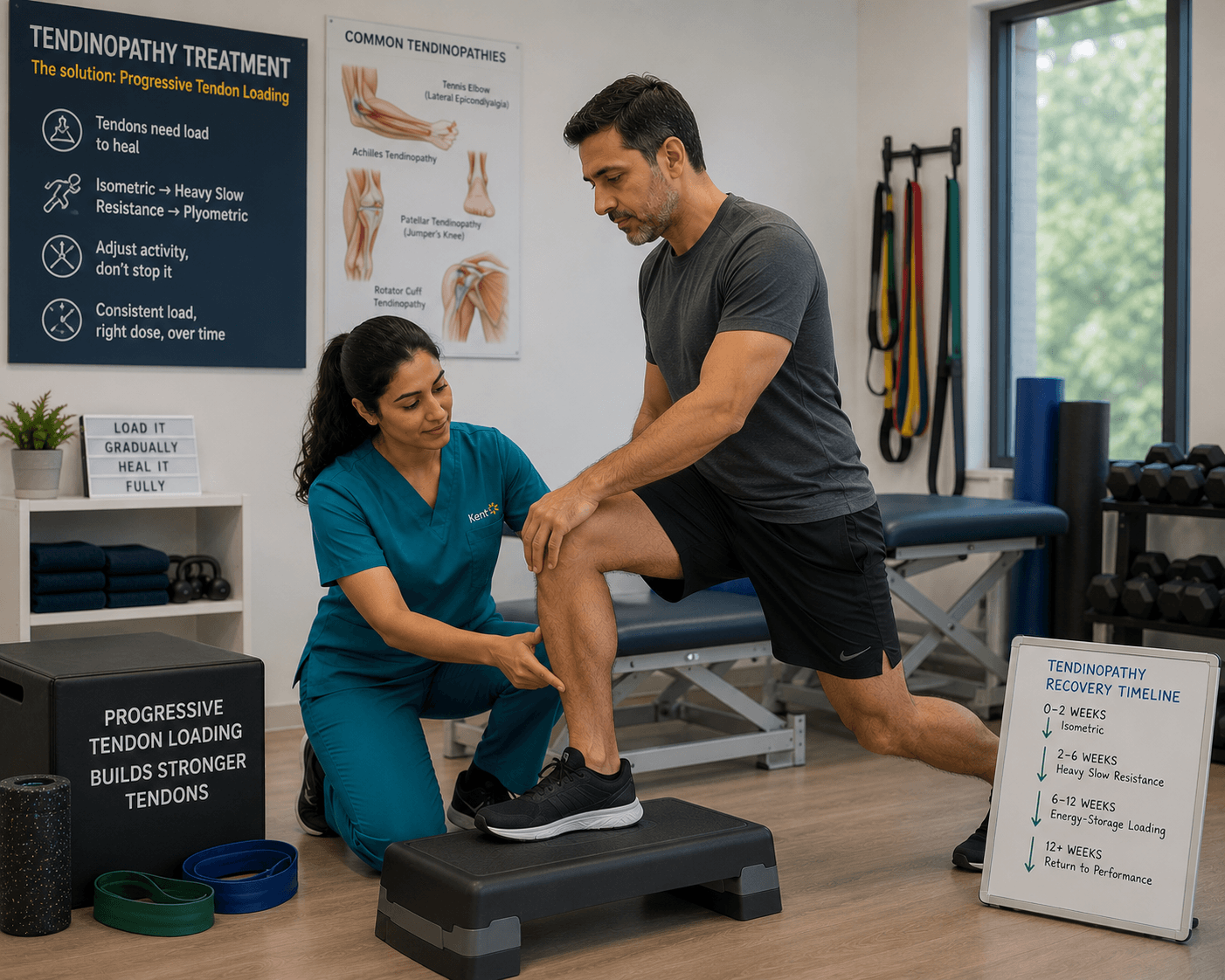
Tendinopathies are not inflammatory conditions that need rest and ice. They are degenerative tendon problems that need progressive loading. Treatment that follows this principle works; treatment that doesn't, doesn't. Most tendinopathies resolve substantially in 8–12 weeks of structured loading, with continued improvement over months.
What we treat
We treat upper limb conditions such as tennis elbow (lateral epicondylalgia), golfer's elbow (medial epicondylalgia), and rotator cuff tendinopathy. Our practice manages lower limb tendinopathies including Achilles tendinopathy (mid-portion and insertional), patellar tendinopathy (jumper's knee), and gluteal tendinopathy with greater trochanteric pain syndrome. Additionally, we provide specialized care for plantar fasciopathy and adductor-related groin pain.
Our approach
Detailed assessment of the affected tendon, surrounding biomechanics, and the load pattern that produced the problem. A progressive loading program—typically isometric to begin (which reduces pain), then heavy slow resistance, then energy-storage loading where sport return is the goal. Education on the principle that tendons need load to heal, but at the right dose. Activity modification—adjusting, not stopping, the activities that triggered the problem. Modalities (shockwave, manual therapy) only where they add value to the loading program.
What we don't do
We don't prescribe rest as the primary treatment for tendinopathy. We don't rely on passive modalities (ultrasound, TENS, ice) as standalone treatment. We don't refer routinely for cortisone injections—the evidence shows they help short-term but worsen long-term outcomes in most tendinopathies.
Outcome measures we use
- VISA-A (Achilles)
- VISA-P (patellar)
- Patient-Rated Tennis Elbow Evaluation (PRTEE)
- Visual Analog Scale During Specific Loading Tests
- Functional Testing Relevant to the Affected Tendon
Who leads this work at Kent
Tendinopathy treatment at Kent is delivered by Labeeb Majid physiotherapist with specific musculoskeletal and sports rehabilitation training.
Frequently asked questions
I've had tennis elbow for months and nothing's worked—can you help?
Yes. Most persistent tendinopathies haven't had structured progressive loading—they've had a mix of rest, brace, ice, and brief manual therapy. Progressive loading, dosed correctly, resolves the majority of cases that have failed other treatments.
Should I rest my tendon to let it heal?
No. Rest reduces tendon load capacity and makes the problem worse on return to activity. The right approach is progressive loading—careful, structured, but active.
What about cortisone injections?
Cortisone injections help short-term but worsen long-term outcomes in most tendinopathies. We don't recommend them routinely. For some specific cases (high-load competitive athlete, brief acute flare) they may have a role, but rarely as a primary treatment.
Do you do shockwave for tendinopathy?
Yes, where clinically indicated. Shockwave can be a useful adjunct for some tendinopathies (particularly Achilles and patellar) when combined with progressive loading—not as a standalone treatment.